George C. Marshall Quotes
I can get billions of dollars with comparative ease, but when I get down to the practical proposition about personnel … all of those billions are futile unless you provide the highly trained personnel.
Marshall was then the chief of staff of the army. He was staving off a Congressional attempt to eliminate the draft.
George C. Marshall, 1880-1959, General & U. S. Army Chief of Staff, U. S. Secretary of State, U. S. Secretary of Defense, Testimony, House Military Affairs Committee, 1941
Sourced by: Eigen's Political and Historical Quotations


The congressman, a member of the House Armed Services Committee, had the most unusual view that no base closing was ever cost effective. His reasoning was that the base so contributed to the economic welfare of the congressional district in which it was located, that even if it contributed nothing to the military effort, it was still worth keeping it operational.

The comparison of the costs of education and military spending is not just a modern phenomenon. In the middle of the 19th century, the same argument was being made.

Webb was opposing the all volunteer army which became a reality despite his and others objections.


To a great extent, the same is true in our modern world.


This is a very important quotation because it and {641522} show the great difficulty that Washington was under and the fact that he repeatedly asked Congress for assistance very little of which was provided. Washington began to be disillusioned about the militias at this time; see {641525} for the conclusions he reached about the state militias.

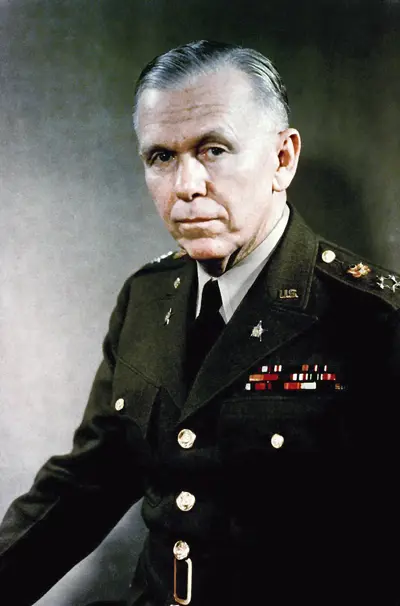
George Catlett Marshall Jr. was an American soldier and statesman. He rose through the United States Army to become Chief of Staff under presidents Franklin D. Roosevelt and Harry S. Truman, then served as Secretary of State and Secretary of Defense under Truman. Winston Churchill lauded Marshall as the "organizer of victory" for his leadership of the Allied victory in World War II. After the war, he spent a frustrating year trying and failing to avoid the impending civil war in China. As Secretary of State, Marshall advocated a U.S. economic and political commitment to post-war European recovery, including the Marshall Plan that bore his name. In recognition of this work, he was awarded the Nobel Peace Prize in 1953.
