Robert M. La Follette Quotes
The draft is the corollary of militarism and militarism spells death to democracy.
Robert M. La Follette, 1855-1925, Governor of Wisconsin (Republican), U.S. Senator (Republican, WI), Presidential Candidate (Progressive), Quoted in The Wilson Quarterly, Summer 1998
Sourced by: Eigen's Political and Historical Quotations


After the breakup of the Soviet Union, NATO expanded to include some fo the former Soviet Nations thus moving NATO territiry to the East--closer to Russia, whose leaders percieved that the expansion was hostile and dangerous for the indpendence of Russia. What made the situation more complex is that the American Secretary of State, when the Soviet Union was very powerful, had made an agreement with the Soviets that in return for Russian aquiessance of NATO being extended to East Germany, NATO would not expand further West. But after the collapse of the Soviet Union, Russia was quite weak and NATO expanded east despite the earleir comittment. The US and th eother NATO counties took the pozition the previous comitmnts were not binidng as they were never formally signed. The Russians then decided to take a hard line position and flaunt and use military force to which would stop the Western expansion closer to the Russian border.

This size standing army which alarmed so many at the beginning of the 20th century, looked very small when compared with the standing army of America a century later. For earlier American Politician’s views on a standing army, see {592824}, {631687}, {622888}, and {641008}.

Congress and most of the Founding Fathers were very distrustful of standing armies. They were aware that standing armies had taken over societies ever since ancient Rome and Julius Caesar.


In early America and up to WWII, generally it was the conservatives like Fisher who were opposed to a strong military and many wanted no military at all except in times of war. It was President Dwight Eisenhower who turned the right wing of America into a pro military force.

Webb was opposing the all volunteer army which became a reality despite his and others objections.


65 years later, this would become a major principle of conservatives, but it was a liberal President who seemed first to make this statement in a major address.


Eisenhower was then Supreme Allied Commander.


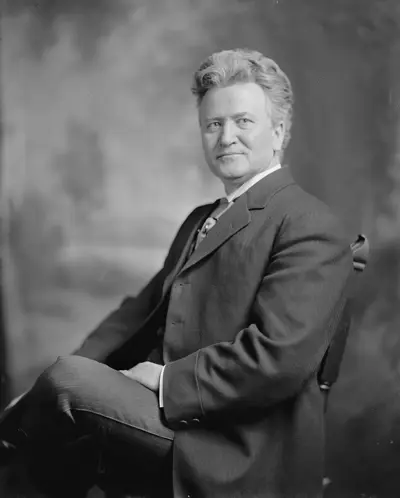
Robert Marion "Fighting Bob" La Follette Sr., was an American lawyer and politician. He represented Wisconsin in both chambers of Congress and served as the Governor of Wisconsin. A Republican for most of his career, he ran for President of the United States as the nominee of his own Progressive Party in the 1924 presidential election. Historian John D. Buenker describes La Follette as "the most celebrated figure in Wisconsin history."
