Charles I Quotes
I ask whether in a case of necessity, for the defense of the kingdom, may I not impose this taxation and am I not the sole judge of the necessity.
called "ship money" to pay for the navy
Charles I, 1600-1649, King of Great Britain & Ireland, Legal question posed to the high court, 1637, The court agreed that the king had such executive, emergency power and that the consent of Parliament was not required for such a tax.]
Sourced by: Eigen's Political and Historical Quotations


Jefferson was opposed to a standing army or a buildup of revenue even in case of war. He thought that a national surplus might tempt an administration to engage in war. This was one of the biggest differences between the Jeffersonians or Republican Democrats as they called themselves and the Federalists led by George Washington and John Adams. Washington was a strong advocate of military preparedness, while Jefferson believed that a nation which had a strong army and war chest would be too easily tempted to use it. That debate has raged in America since. However, at the beginning of the second world war, the then conservative party, the Republicans, had adopted the Jeffersonian view and it was FDR and the Democrats arguing for armament and preparedness. The United States was terribly unprepared for war, but mobilized rapidly and won the day. Since then both parties have supported military preparedness and the political argument has been over the degree, but there are few Jeffersonians left when it comes to military preparedness.

The prerogative of preparedness weakens after a war is won; everyone expects some sort of peace dividend.


money for the king's government In 1628 there was a classic English struggle between the king, Charles I, and Parliament. While Parliament was sitting, Dr. Manwaring, an Anglican Bishop, preached a sermon. He claimed that God intended all private property to be at the disposal of the King in times of national emergency. Further, that the King could levy an taxes without the consent of Parliament. The King liked the sermon so much that he had it printed and distributed by special command. The House of Commons went bonkers and impeached Manwaring. He was imprisoned by order of the House, fined the then huge sum of 1,000 pounds, and prohibited from holding any ecclesiastical or secular office in the future. As soon as the session of Parliament ended, the king pardoned him, gave him a huge salary raise, and several years later Manwaring was appointed Bishop of Asaph. King Charles I, perhaps England’s worst sovereign, then provoked two civil wars and was finally tried for treason and beheaded. Manwaring was in and out of prison during the conflicts. He faded from public view.


Vidal, a staunch liberal held this view along with many ultra conservatives end extreme liberals. The constitution requires the Congress to declare war, but they have not done so for any of the wars since WWII. The President assumed the war power. And the only coherent budgets began.

This quotation is very important because it illustrates in the first of our great national political debates, the same views held by extreme, right wing anti-government, and Tea Party adherents regarding government in general and taxation in particular. See {634235} and {634234} for more of his arguments at the Ratification Convention.

This was a rebellion of the Irish natives of Ulster against the English Protestants land owners and the English settlers. In addition to the desire for liberty as this proclamation formally states, the rebels were mostly Roman Catholics whose religion had been almost destroyed the thought by the English component of the Protestant Reformation. 12 years after this proclamation, he was executed.

A negotiated end to the war made sense for both sides. The English budget was in terrible shape with the huge costs of dealing with Napoleon and although Liverpool wanted to teach the Americans a lesson, he could not get the money to finance it. The Americans could prevent British conquest but they could not defeat the British overall or eject them from the continent.

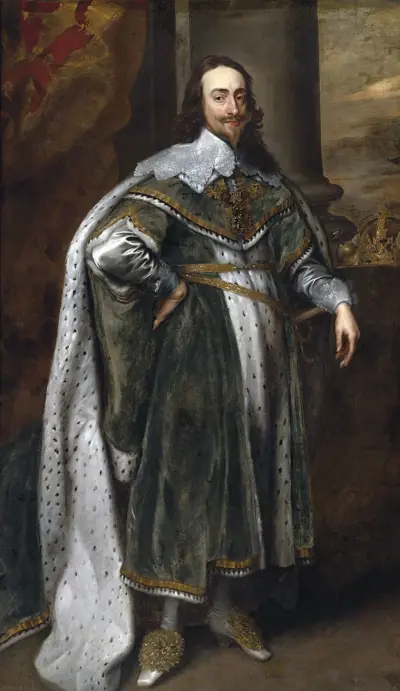
Charles I was King of England, Scotland, and Ireland from 27 March 1625 until his execution in 1649. He was born into the House of Stuart as the second son of King James VI of Scotland, but after his father inherited the English throne in 1603 (as James I), he moved to England, where he spent much of the rest of his life. He became heir apparent to the three kingdoms of England, Scotland, and Ireland in 1612 on the death of his elder brother Henry Frederick, Prince of Wales. An unsuccessful and unpopular attempt to marry him to the Spanish Habsburg princess Maria Anna culminated in an eight-month visit to Spain in 1623 that demonstrated the futility of the marriage negotiations. Two years later, he married the Bourbon princess Henrietta Maria of France.
