Marcus Garvey Quotes
I am accused of creating dukes, barons and knights. But who gave the white man the sole right to create the social order.
Garvey created titles and made appointments to the joy of many and the embaraqssment of others.
Marcus Garvey, 1887-1940, Black Nationalist Leader and Founder, Universal Negro Improvement Association, Quoted on PBS Marcus Garvey, February 12, 2001
Sourced by: Eigen's Political and Historical Quotations


The power structure of England and the English administrators of South Africa were strong advocates of racial equality at the beginning of the 19th century. They insisted on equal administration of law. However the Boer white population could think of nothing more absurd. In a sense the Boers were much like the Southern Whites at the same time. The South African government however could not enforce its equality policies in the rural area – the majority of South Africa at the time. When democracy and self rule came to South Africa, the racially moderating force of the English was minimized and the majority of South Africans wanted a racially segregated society. Apartheid resulted.

Many social scientists believe that this is one of the reason for so much racism amongst the lower class whites. If blacks are “below” them, the poor whites have power and are not at the bottom of the sociological pyramid of society. To many this is better than being better off themselves but starring the bottom with the Negroes.

Hammond’s rhetorical tactic was to then argue that it was better to have Blacks be the lower class than whites—hence slavery was a logical conclusion.


She was one of the first prominent white southerners to denounce racial segregation.


She was one of the first prominent white southerners to denounce racial segregation.

There had been an Ethiopian aristocracy that via inbreeding had tended to have lighter skins and that created over the centuries a discriminatory society based on skin color. Although a brutal, criminal, dictator, he initiated some worthwhile reforms although his methods were reprehensible.


Robert Allen Zimmerman

The Boers were lower class, uneducated, farmers from Holland who came to South Africa before the English did. They were at the bottom of the Dutch socioeconomic ladder. Unlike the English who were interest in establishing a trading colony, the Boers just wanted to own and farm the land and use blacks as slave or cheap labor. The Dutch Government and Trading companies lost interest in South Africa as there were much more profitable parts of the world, and they felt no obligation to the Boers whom they were glad to be rid of. So the Boers found themselves having to follow the British laws and rules of the British Colonial Office. Slavery was outlawed, and Blacks could be educated and become citizens under British law. They could own land, and contest the right of the Boers who had settled in some uninhabited land and some that was owned by Black tribes. The Blacks outnumbered the whites in general and the Boers, and there were educated Blacks who “outclassed” the still relatively uneducated Boers. So the Boers, fighting for their “way of life” set up their own area in Southern Africa and claimed independence. But Blacks claimed that it was their land and looked to the British to exercise English law. The Boer war ensued. Although the Boers lost the war, the bred at a much faster rate than the English, many of whom did not even have their families in South Africa. By the end of WWII, the Boer white majority controlled the government and kept the majority Blacks from voting and having full citizenship rights. They dominated Apartheid South Africa until the Black Revolutionists obtained control and although Black and white relations are better in South Africa than most countries, the extemeist Boers and most militant Blacks are in political, but not violent, conflict. Churchill and the British have always perceived themselves as being caught in the middle between the Boers and the Blacks.


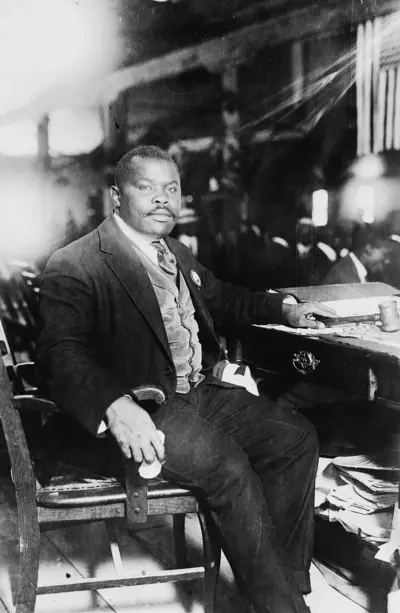
Marcus Mosiah Garvey Sr. ONH was a Jamaican political activist, publisher, journalist, entrepreneur, and orator. He was the founder and first President-General of the Universal Negro Improvement Association and African Communities League (UNIA-ACL, commonly known as UNIA), through which he declared himself Provisional President of Africa. Ideologically a black nationalist and Pan-Africanist, his ideas came to be known as Garveyism.
