DeWitt Clinton Quotes
Human laws are entirely destitute of the sanction of rewards. To confer honors for obedience would be as ridiculous as unavailing. The honor of many would resolve itself into the honor of none. To dispense pecuniary rewards would be nugatory or impracticable. In an unqualified extent, no government would be able to supply the funds; and even in a restricted form, its operation would be to receive money with one hand as a premium, and to pay it back with the other in the shape of a tax.
Even in the 19th century advanced thinkers suspected that positive rewards were more effective in shaping behavior than negative reinforcement which was proven in the 20th century. However, monetary rewards for obedience to laws was and is impractical as Clinton pointed out in this quote.
DeWitt Clinton, 1769-1828, U. S. Senator (Anti-Federalist Republican, NY), Mayor of New York City, Governor of New York, Peace Party candidate for President of the United States, “Father of Free Public Schools", Speech, American Bible Society Convention, New York City, May 8, 1823
Sourced by: Eigen's Political and Historical Quotations


This is one of the major reasons that the relations between police and the communities they are policing is so important. Also, the style and courtesy that the IRS tax collectors exhibit is very important.


At the time many of the powerful and influential upper class felt that some of the laws did not necessarily apply to them or their corporations. They bribed legislators to change laws when they were inconvenient to ignore. Roosevelt was the first President to take them on.


Trashing government’s ability to do things was not new to the Ronald Reagan era and after. It had a long history.

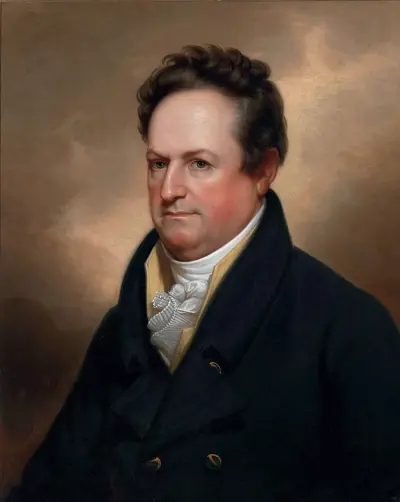
DeWitt Clinton, whose name was almost always spelled De Witt during his lifetime and until the late 20th century, was an American politician and naturalist. He served as a United States Senator, Mayor of New York City, and as the sixth Governor of New York. In this last capacity, he was largely responsible for the construction of the Erie Canal. Clinton was a major candidate for the American presidency in the election of 1812, challenging incumbent James Madison.
