Pippin III Quotes
How many divisions does the Pope have.
Pippin had the opportunity of expanding his empire by conquering the Lombards whose cavalry he could use if and when the Saracen Muslims would invade again. But he would be seizing another Christian country, contrary to the Pope’s edicts, thus losing the blessings of the Pope. Hence the question. He decided to go for the cavalry. Later, Joseph Stalin asked the same question in much different context. See {627524}. Some historians question whether Pippen actually uttered the quotation or just considered it.
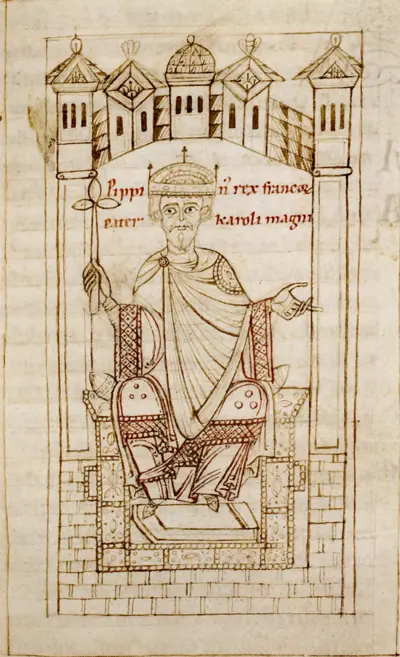
Pippin III, 714-768, Pippin the Short, First King of the Frankish Carolingian Dynasty, Son of Charles Martel, Father of Charlemagne, Question he asked when considering his strategic choices, Quoted in David Levering Lewis, God’s Crucible, 2008
Sourced by: Eigen's Political and Historical Quotations

His response was to being asked whether he could do something with Russian Catholics to help Laval win favor with the Pope, to counter the increasing threat of Nazism. This quotation is often used as an example of Stalin’s disrespect for the Papacy. However, in this case, the Pope was extremely weak politically and some argue spiritually for he did not oppose Hitler and the Nazis very much. Defenders of the Papacy argue that Hitler had overwhelming force and little respect for the Pope, and ironically this was what Stain was referring to. Ironically, another Pope, John Paul, had a major part in bring down the Soviet Union and he had no divisions.


The Holy Roman Emperor and the Pope were at odds. The Pope had issued an edict staking out the powers of the Pope. King Henry called a conclave of clerics and deposed Pope Leo VII. The Pope Excommunicated Henry and deposed him as king and emperor. Civil war ensued, and finally they reached a compromise and accommodation with each other." Saint Hildebrand

During the presidential debates George W. Bush stated that he would be very hesitant to use the military for nation building around the world. Less than a year later, the Bush administration, faced with the September 11, 2001 terrorist attacks, launched a massive attack on the Taliban regime in Afghanistan. After fighting and winning the war, the military soon realized that they would in fact be involved in nation building. However, with the assistance of the United Nations much of the humanitarian burden was lifted from the U.S. military.


Smith was the first Roman Catholic to run for President. He was very popular but there was a substantial amount of anti-Catholicism in America at the time. He lost, probably by the margin of the anti-Catholic vote.

In early America, there was great concern about a standing army—a military force that exists and is organized in peacetime. History showed the founding fathers that tyrants who siezed power almost always did so by getting control of the standing army. The logic was if there is no standing army, no one can control it and therefore no tyrant can control the country by force. At the time, however, with oceans protecting us, there was penty of time to mobilize a defensive army should any foreign power invade. However, with modern military technology, and the importantance of retaliation as a protective3 strategy, it is virtually impossible to not have a standing army and stoll be secure.

The Army and the other power centers of the country did not appreciate this idea. He was assinated in a coup 4 year later.


King Henry VIII had left the Roman Catholic church and taken England and Ireland out also. He replaced the Pope as the head of the English and Irish churches. There was much opposition in Ireland and the priests were the most assertive opponents to the change and were still loyal to the Pope. Queen Elizabeth continued to have problems with the Priests. James I, Elizabeth’s successor, became fed up by the Roman Catholic Priests and therefor issued this Proclamation.


Congress and most of the Founding Fathers were very distrustful of standing armies. They were aware that standing armies had taken over societies ever since ancient Rome and Julius Caesar.

Mao and other Chinese leaders molded the people into an Army to fight the invading Japanese in WWII after which they were attacked by Chiang Kai-shek’s Nationalists. In a remarkable trek of escape the Communists moved across China to escape the nationalists while the Red Army provided protection. Without the Red Army, the Communists would easily have been overrun then and after the Nationalists “escaped” to Taiwan they planned and threatened to invade the mainland. It was the Red Army that kept them at bay, and so the “People’s Army” has an emotional, historical and intellectual impact and role even in 21st Century China when there really are no enemies that would attack China.


This has been the case ever since WWII. In the Great March where the Communists avoided capture by the Nationalists, the army, the party, and many of the people were in a single amalgam living on the move. The positive and fair behavior of the Communist army during the Great March did a great deal to convince the Chinese peasants that the Communists were not corrupt and greedy as were most of the Nationalist officials they ran into. From a strict military point of view, there was little for the Army to do for defense and national security since the overthrow of the Nationalists. So they have been great supporters of development of the nation after the revolution, but by the 21st century had developed some of their own corruption and built companies to produce funds for the army (and some of its leaders personally.


FDR, Eleanor and lost liberals of the time were advocates of a strong military, and unlike after the 2nd Word War, most of the Republicans were conservative isolationists who were opposed to spending much public money for the armed services or weapons.
- Born:
- Died: September 24, 0768
- Nationality:
- Profession:
Pepin the Short, also called the Younger was King of the Franks from 751 until his death in 768. He was the first Carolingian to become king.
