Mao Zedong Quotes
Without an army for the people, there is nothing for the people.
Mao and other Chinese leaders molded the people into an Army to fight the invading Japanese in WWII after which they were attacked by Chiang Kai-shek’s Nationalists. In a remarkable trek of escape the Communists moved across China to escape the nationalists while the Red Army provided protection. Without the Red Army, the Communists would easily have been overrun then and after the Nationalists “escaped” to Taiwan they planned and threatened to invade the mainland. It was the Red Army that kept them at bay, and so the “People’s Army” has an emotional, historical and intellectual impact and role even in 21st Century China when there really are no enemies that would attack China.
Mao Tse-Tung, 1893-1976, Chairman, Communist Party of China, Chinese Revolutionary Leader & Political Philosopher, Founder, The People’s Republic of China, The Little Red Book, Chapter 9, 1964
Sourced by: Eigen's Political and Historical Quotations

In early America, there was great concern about a standing army—a military force that exists and is organized in peacetime. History showed the founding fathers that tyrants who siezed power almost always did so by getting control of the standing army. The logic was if there is no standing army, no one can control it and therefore no tyrant can control the country by force. At the time, however, with oceans protecting us, there was penty of time to mobilize a defensive army should any foreign power invade. However, with modern military technology, and the importantance of retaliation as a protective3 strategy, it is virtually impossible to not have a standing army and stoll be secure.


Congress and most of the Founding Fathers were very distrustful of standing armies. They were aware that standing armies had taken over societies ever since ancient Rome and Julius Caesar.


This was an official publication of the U. S. Army. The First World War had very little affect on future military preparedness At that time conservatives in Congress were very isolationist and military preparedness was not a high priority or even a significant political issue. The Democrats then were more supportive of military spending than the Republicans. It took World War II, for which America was very unprepared, to produce a change in public and political opinion regarding military preparedness.


During the presidential debates George W. Bush stated that he would be very hesitant to use the military for nation building around the world. Less than a year later, the Bush administration, faced with the September 11, 2001 terrorist attacks, launched a massive attack on the Taliban regime in Afghanistan. After fighting and winning the war, the military soon realized that they would in fact be involved in nation building. However, with the assistance of the United Nations much of the humanitarian burden was lifted from the U.S. military.


Commenting on the hostilities between the Baltic states and the Russian government:

President James Madison expressed a similar sentiment in his first inaugural address.

Monroe was then Secretary of State and the U. S. was at war.
America is almost unique among nations where the military has never been a force that either dominated or controlled the government or acted independently from it. The Founding Fathers knew well the history of Europe and other nations, and built many checks into our Constitution and our traditions with George Washington, setting the example for American military men forever after.


This was a fairly unique notion. In Russia the army never played this role to the same degree. The Long March in Chinese History blended and amalgamated the people and the army in a way that was unique in World History.


This was the first exposition of what turned out to be the winning Presidential Campaign strategy in 2004.


Greek invaders were marching on Istanbul
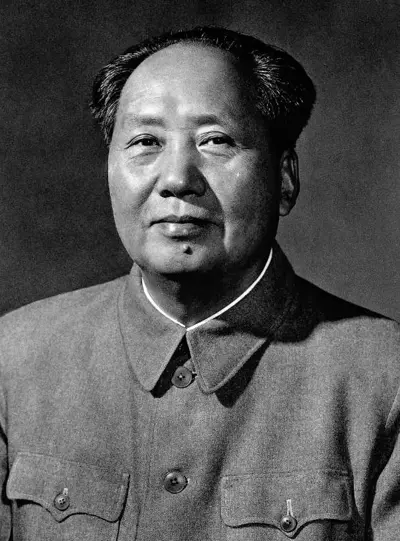
Mao Zedong, also known as Chairman Mao, was a Chinese communist revolutionary who was the founder of the People's Republic of China (PRC), which he ruled as the chairman of the Chinese Communist Party from its establishment in 1949 until his death in 1976. Ideologically a Marxist–Leninist, his theories, military strategies, and political policies are collectively known as Maoism.
