Daniel Dulany Quotes
From Virginia and Maryland are exported communibus annis 90,000 hogsheads of tobacco to Great Britain of which it I supposed 60,000 of them are then exported. But these colonies not being permitted to send their tobacco immediately in proportion to their [foreign] demands, the re-exported tobacco pays double freight, double insurance, commission and other shipping charges. If the [other British] colonies were not restrained from directly importing foreign commodities they would … pay less for them, even by 50 percent, than they do at present
This was one of the first and is considered the best of the Colonial arguments against taxation without representation. The argument here about exports also affected other commodities—see {636866}. Despite this, Dulany is not well known in American history because when the Revolution finally came he was a loyalist.
Daniel Dulany (The Younger), 1722-1797, Attorney, Pamphleteer, Mayor of Annapolis, 1765
Sourced by: Eigen's Political and Historical Quotations

He was a rice planter but could only export his rice to English Merchants and not sell to other foreign markets. This was the same with tobacco and other commodities. See {636867}.

The American colonists were not allowed to sell their tobacco or other products to foreign nations. They could only sell them to English merchants who in turn would sell them to foreign markets. Thus, the large profits on American tobacco were made by English merchants and not by American farmers or merchants.

This was an expression of concern from the merchants of Rhode Island to England regarding curtailing aspects of the slave trade. Ironically, this Remonstrance is one of the first documents objecting to the management of America’s affairs by England when America had no representation. Therefore it played a part in the process which culminated in the American Revolution and freedom from England. And yet the subject was not freedom at all but just the opposite—the prerogative of maintaining the slave trade. Note that the appeal to the Board of Trade was not couched in ethical or political argument but as a mercantile argument—Rhode Islander’s would import less British goods.

The French had a much different agenda in the new world than the British who wanted to create residential colonies. The French were more interested in trade—not in establishing permanent colonies. The result was that the French were in many ways better trading partners for the Indians than the English. They came without women, intermarried among the Indians and learned the languages; they did not contest for land, and they paid the Indians more for pelts and furs than the English were willing to. At the same time they exacerbated conflicts with the colonists, and encouraged Indian attacks on settlers as that kept competition out. They were not above giving Indians alcohol and encouraging them to rob the furs and/or kill their English competitors. So on two levels, they had to be removed. See the military view of Robert Rogers: {614122}.

This agreement was not a law as an English colony like South Carolina could not pass a law that prohibited buying English merchandise. It was unofficial and great pressure was put on any citizen who would not sign it. The merchants that did import goods other than those allowed in the agreement were boycotted by most of the signers. This quotation illustrates what may have been the first organized protectionist actions to assist domestic producers and manufacturers. It is valuable for another reason. The quotation lists goods that are exempted from the boycott. These were goods that were not made in South Carolina or nearby states at the time since if they were, they would have been protected, So we can learn what was manufactured in the colony or nearby at the time—that which is nit on the list but was important to colonial life. The list tells us what was not manufactured locally, and one of the most important were firearms and ammunition. The inability to manufacture armaments plagued the colonies and early America after the revolution. One of the major public expenditures was to create and subsidize domestic arms manufacture.

We are so used to hearing the freedom seeking reasons for the American Revolution that we overlook the more selfish and venal motives. This quotation shows that the large merchants of the colonies had banded together in an illegal conspiracy trust and monopoly and managed to keep many British competitive products out of the colonies. The British, for equally venal reasons, began to enforce the laws in favor of free trade. Many large American merchants were getting huge profits (and American consumers paying more) from their protectionist illegal monopoly. A Revolution would de facto assure that monopoly for many years to come, so they became supporters—patriots—of the American Revolution. As the Revolution drew closer, the Americans made efforts to protect the protectionism and monopoly of some of the richest Americans. See {636861}.

This historical quotation enables us to date the importation of slaves into Massachusetts to as early as 1638. It also shows us that even though the Spanish had enslaved Negroes from Africa, when English ships raided Spanish ships and seized their booty, they considered the slaves as property and took them to then sell for the money. Had they had a different point of view, they might have freed the Back slaves who had been captured by their enemy, the Spanish. But they did not and money and money was the major motivation.


He was one of the strongest English advocates of colonization of the New World

He was asking for permission to issue more paper currency.

The Virginia Colonial Governor returned to England to protest the economics of the tobacco trade and the monopolies that then prevailed:

“Sir Robert” was Prime Minister Robert Peel. See {630737}.

The American Colonies were very diverse culturally, educationally, sociologically and economically as the States are in modern times. Despite the intellectuals of Boston, most of New England at the time of the Revolution was much less sophisticated than New York and Philadelphia.


There was, well before the American Revolution, a restriction on the importation of British goods into the American colonies. Partially this was to pressure Parliament to stop some of its most repressive lawmaking. But it also supported what had become a very lucrative protectionist monopoly of large American merchants. See {636861}.

It was the Dutch that first founded New York and there were many mercantile relationships existing between New Yorkers and Dutch merchants. Initially, the Dutch gunpowder was smuggled into New York because it was less expensive than English gunpowder or gunpowder from Kentucky or other parts of America. (The transportation costs by ship from Holland were much less than the overland cost from Kentucky.) By 1774, there was great friction between American patriots and the British and the smuggling was used to stockpile gunpowder for a possible revolutionary war. See {636944} for insight into the gunpowder shortage.

2nd Earl of Guilford. This bill cut off all trade with the American Colonies. It was meant as pressure to cease the rebellion. It did not work.

See {641497} for a quote from the Grenville speech. Fox, a conservative on most issues was an absolute radical on the issue of America. To aggravate the hawks in parliament, he used to dress in the colors of George Washington’s uniform to show his support once the war broke out.

This is how the American patriots obtained the tea that was thrown into Boston Harbor during the Boston Tea Party.
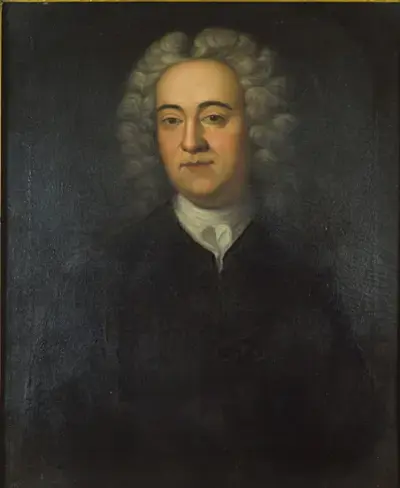
- Born:
- Nationality:
- Profession:
Daniel Dulany the Elder (1685–1753) was a prominent lawyer and land-developer in colonial Maryland, who held a number of colonial offices. In 1722 Dulany wrote a pamphlet entitled The Right of the Inhabitants of Maryland, to the Benefit of the English Laws, asserting the rights of Marylanders over the Proprietary Government.
