John Winthrop Quotes
Mr. Pierce in the Salem ship, the Desire, returned from the West Indies after seven months. He had been at Providence, and brought some cotton, and tobacco, and Negroes, etc., from thence, and salt from Tertugos. Dry fish and strong liquors are the only commodities for those parts. He met there two men-of-war, sent forth by the lords, etc., of Providence with letters of mart, who had taken divers prizes from the Spaniard and many Negroes.
This historical quotation enables us to date the importation of slaves into Massachusetts to as early as 1638. It also shows us that even though the Spanish had enslaved Negroes from Africa, when English ships raided Spanish ships and seized their booty, they considered the slaves as property and took them to then sell for the money. Had they had a different point of view, they might have freed the Back slaves who had been captured by their enemy, the Spanish. But they did not and money and money was the major motivation.
Winthrop, John. Winthrop's Journal, "History of New England," 1630-1649, edited by James Kendall Hosmer, vol. 1, Charles Scribner's Sons, 1908, p. 260.


In 1672, the English trading company, the Company Of Royal Adventurers, rechartered itself changing it name to the Royal African Company to focus on the Slave Trade. By 1687 the company was given the exclusive right to trade between the Gold Coast and the British colonies in America. James, Duke of York, (later to be King James II, was interested in this company, and it agreed to supply the West Indies with three thousand slaves annually. in 1698, on account of the incessant clamor of English merchants, the trade was opened generally, and any vessel carrying the British flag was, by act of Parliament, permitted to engage in it on payment of a duty.

This was an expression of concern from the merchants of Rhode Island to England regarding curtailing aspects of the slave trade. Ironically, this Remonstrance is one of the first documents objecting to the management of America’s affairs by England when America had no representation. Therefore it played a part in the process which culminated in the American Revolution and freedom from England. And yet the subject was not freedom at all but just the opposite—the prerogative of maintaining the slave trade. Note that the appeal to the Board of Trade was not couched in ethical or political argument but as a mercantile argument—Rhode Islander’s would import less British goods.

Many people are surprised that such an anti-slavery could have passed given the Southern states’ position regarding slavery. However, this resolution did not end slavery—just American participation in the slave trade. This would have actually increased the value of the existing slaves in the colonies as “cheap imports” would no longer depress the value of American slaves. The Southern perception was there were enough slaves for their needs and they could breed more. The other states, generally opposing slavery took what they could get---a ban on the slave trade. A major economic fact of the time was the vast majority of the slave trade imports were going to the British Colonies in the Caribbean. Cutting off the American slave trade would do much more harm to the economic interests of Britain than the United States where the only people economically hurt would be the Yankee captains and slave traders who were not very popular of politically connected except in Rhode Island.


This quotation—presented in its entirety because it is so unbelievable—illustrates one of the uglier and nasty aspects of Colonial America. Most of us associate early American colonists with persecuted minorities escaping the intolerance of Europe, but so much of the concept of tolerance then concentrated on the rights of a religious community but provided little if any obligation to then be tolerant of OTHER minorities in their colonies and communities. In this case, Massachusetts Christians did not perceive Quakers as either Christians or another sect to be tolerated. They not only wanted the Quakers stopped from coming to other parts of America, but actually attempted to interdict the Quaker immigrant ship, capture the Quakers, and sell them into slavery in the Caribbean. What makes the incident even more offensive is that the ethics of this was never questioned and was even justified as Christian acts and even duty. The Welcome evaded the Porpoise The founding fathers knew about these incidents and the religious discrimination that was rampant in many Colonial communities as bad as England and Europe. Hence, the separation of Church and State concepts were not just protections against the way of the old world, but dealt with a clear and present danger that Colonial history had demonstrated.


The perception of the necessity of slavery was evident very early in the South.
Downing was the brother-in-law of the Governor. Many people think that the Puritans were very moral people but they were not that so much as rigid. There was no moral compunction for example against slavery as this letter shows.

This is a remarkable analysis given the prejudices of the time. Second to Benjamin Franklin, Rush was the only other real scientist of the American colonial era.


This was one of the first and is considered the best of the Colonial arguments against taxation without representation. The argument here about exports also affected other commodities—see {636866}. Despite this, Dulany is not well known in American history because when the Revolution finally came he was a loyalist.


This is how the American patriots obtained the tea that was thrown into Boston Harbor during the Boston Tea Party.

He was also himself a ship owner in the slave trade and he was the brother of the leading Rhode Island abolitionist, Moses Brown. See {585793}. Brown became the first American, prosecuted in federal court for illegal slave trading –-- a prosecution brought, in part, by his own brother. He was, however, acquitted.

The Parliament was debating the reaction to the Stamp Act by the American Colonies. One of the members, reflecting a majority view, asked sarcastically when the American Colonies had been emancipated so that they could make their own independent decisions. Pitt then hit this one out of the park by reversing the question.
Most Canadians supported the English despite the letter.


He was asking for permission to issue more paper currency.
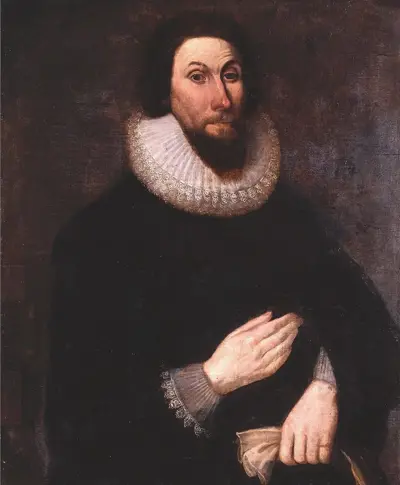
John Winthrop was an English Puritan lawyer and one of the leading figures in founding the Massachusetts Bay Colony, the second major settlement in New England following Plymouth Colony. Winthrop led the first large wave of colonists from England in 1630 and served as governor for 12 of the colony's first 20 years. His writings and vision of the colony as a Puritan "city upon a hill" dominated New England colonial development, influencing the governments and religions of neighboring colonies.
