Benjamin Rush Quotes
I need say hardly anything in favor of the Intellects of the Negroes, or of their capacities for virtue and happiness, although these have been supposed by some to be inferior to those of the inhabitants of Europe. The accounts which travelers give of their ingenuity, humanity and strong attachments to their parents, relations, friends and country, show us that they are equal to the Europeans.… All the vices which are charged upon the Negroes in the southern colonies, and the West Indies, such as Idleness, Treachery, Theft and the like, are the genuine offspring of slavery, and serve as an argument to prove, that they were not intended, by Providence, for it.
This is a remarkable analysis given the prejudices of the time. Second to Benjamin Franklin, Rush was the only other real scientist of the American colonial era.
Benjamin Rush, 1745-1813, Physician & member of the Continental Congress, Surgeon General of the Continental Army and Treasurer of the U.S. Mint, On Slavekeeping, 1773
Sourced by: Eigen's Political and Historical Quotations


See {625675}, {625686}, {625684}, {625683}, {625676} for additional quotations arguing for Black emigration.


When the first Southern States seceded, each appointed a whose job it was to persuade the other Southern States to also secede. In this case Hale was marketing secession to Kentucky which with Maryland were the only two Southern States to reject what they regarded as treason and rebellion. The importance of the quotation however is in his argument which was all based on enmity to racial equality and abolition. Later Southern apologists would argue that the Civil War was fought, not about slavery and racism butt about different philosophies of government. See {623715} .

The letter was written in the supposed style of a Black after Emancipation and includes most of the ugly false stereotypes of the worst of the racists of the present and the slaveowners of past times. Williams stated that he was not a racist and was trying to make a point about freedom required risk and responsibility. However, the effort was interpreted by many people, Black and white, to be insulting and a put down of African Americans. At the same time, although most of the Tea Party members were not racists, most of the racists in America were supporters of the Tea Party. Those people interpreted the quotation as "telling it like it is" about Blacks who do not want the responsiblities and risks of freedom and are not yet developed sufficiently to be equal citizens in a democracy.

The early laws regarding slaves were more protective in earlier Colonial America than they were after independence. In Colonial America all local laws and the enforcement thereof were subject to the government and king of England. When the Constitution was passed with the understanding that Slavery issue was not to be even discussed in Congress, there was NO OUTSIDE ENTITY to check any laws or lack of laws or the enforcement thereof. The Southern States were a law unto themselves on the slavery issue and the system became even more brutal and cruel with no moderating force. When such a force seemed close with the Republican 1860 victory, the South seceded. Then war was the moderating force.

Supervisors of black soldiers reminded them that

This quotation is very important for in the 20th century Southern revisionists made a major effort to ennoble the Confederate cause by claiming that Slavery and the desire to keep Blacks in bondage and unequal was just of byproduct of the reason for secession—States Rights and the decentralization of government. Many of the school history books were changed to reflect this claim. However, each of the seceding states left a legislative record of secession and the reasons for it. In all cases, Slavery and the preservation of Slavery in the South was the central and in most cases the only reason stated. In this case, Texas made its reasons clear. There was nothing noble therein but racism and racial exploitation.


Note that Nixon attributed Rogers views on Blacks to the fact that Roers was from New York City which Nixon viewed as a hotbed of liberals and minorities. This quotation was uncovered in 2010 when more of the Nixon White House tapes were released. Nixon tended to have the worst stereotyped view of all minority groups. The implication of the inbreeding is a high percentage of mental retardation. It was never been established that the Black slaves in America were inbred as they came from many different tribes and slave owners did not attempt to have slaves of a single or even two tribes. There was a great deal of diversity. If anything Southern Whites were in danger of inbreeding as it was the custom for many first cousins to marry. This was just another of Nixon’s hateful, racial remarks based on no foundation of fact.

Jamaica, then part of the British Empire which had outlawed slavery, was quite racially integrated with negroes and mulattos in civil positions such as magistrate. When the ship landed, the slave, John Anderson, was kept locked below deck since if he ran off and reached shore, the Jamaican authorities would have declared him a free man. The presence of the captive negro slave leaked out and a group of Jamaicans boarded the ship uninvited and forcibly removed Anderson, He was taken before a Jamaican magistrate who declared him a free person. The ship’s captain demanded that the authorities return the American private property which had been stolen from an American ship by a “mob”. Harrison, the US Counsel complained to the Jamaican Governor of the “Insult” to the American Flag that had taken place and demanded redress. In both efforts, the original decision of the magistrate was supported and Anderson was a free man. Harrison, an ardent Southerner from Virginia was apoplectic and asked the State Department to make this case a major issue in relations with London. His description of the public opinion then in Jamaica was classic. His racial bias was even supplemented by a virulent anti-Semitism because not only had Jewish Jamaican merchants supported abolition of slavery but some had intermarried with Negroes who had converted to Judaism.

Some whites opposed Slavery and new slave states, not becasue of any sympathy with Negroes or concern for the immorality of slavery, but becasue slavery made it difficult for the working white man to thrive.

This law required the treatment of Blacks as whites were then treated with respect to indentured servitude—a limit of 10 years after which the person would be free. However, this law was poorly enforced. The “General Court” was the name for the legislature of the Rhode Island colony.


The great contralto singer, Marian Anderson, an African American, had been refused by the Daughters of the American Revolution the use of Constitution Hall as a venue for her concert based on their White Performers Only policy. First Lady, Eleanor Roosevelt, resigned in protest from the DAR and she and the President asked Secretary Ickes to arrange a public concert at the Lincoln Memorial and he did. There was no Civil Rights Act at the time.
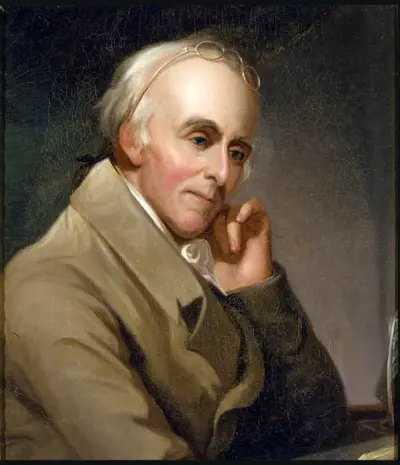
Benjamin Rush was a signer of the United States Declaration of Independence and a civic leader in Philadelphia, where he was a physician, politician, social reformer, humanitarian, and educator and the founder of Dickinson College. Rush attended the Continental Congress. His later self-description there was: "He aimed right." He served as Surgeon General of the Continental Army and became a professor of chemistry, medical theory, and clinical practice at the University of Pennsylvania.
