George W. Bush Quotes
For the President to perform his constitutional duties, it is imperative that he receive candid and unfettered advice and that free and open discussions and deliberations occur among his advisors and between those advisors and others within and outside the Executive Branch.
In recent years, presidents of both parties have refused to allow Congress in its oversight responsibility to question certain assistants or see certain documents that are not technically national secrets. The questionable legal principle, executive privilege, supposedly assures that the President can get honest confidential advice without the advice giver feeing intimidated that the advice will become public. However, Presidents have also used this principle to cover-up scandals, wrong doing, and incompetence. Since the President simply asserts the “privilege” there is no way of checking in any particular case to determine if it is an abuse or not.
George W. Bush, 43rd President of the United States, Son of President George W. Bush, Statement asserting “Executive Privilege” to stop Congress from learning the details about U. S. Attorney firings, Statement June 28, 2007
Sourced by: Eigen's Political and Historical Quotations

He was Chief of Staff and was trying to calm the nation. However, he created a real problem. By saying he was in control, he alarmed many people as the Constitution did not give him any authority to be in control of anything. Many people saw this as a sign of his extreme personal ambition. Others, that he had just made a mistake.

Alberto Gonzalez, White House Counsel and later Attorney General who was forced to resign and David S. Addington, Counsel to the Vice President, had come up with a novel view of the powers of the presidency. They argued that since the President is the Commander in Chief, in a war situation or intelligence gathering thereto, has the Constitutional responsibility for that function, he need not obey any laws of Congress as in the conduct of the war Congress would be impinging on the Constitutional separation of powers which itself was prohibited by the Constitution. The argument did not find any significant legal support but for a while the George W. Bush White House behaved as if this were the law, despite the fact that even in the American Revolution and the War of 1812 Congress passed laws regulating the conduct of the armed forces as is provided for in other parts of the Constitution. Yet even Goldsmith would allow the President some powers that many think are unconstitutional and/or belong to Congress. See {32436}.


Monroe was then Secretary of State.


This was a very clever play on a slogan that Las Vegas was using at the time to promote tourism and gambeling: “What happens in Las Vegas stays in Las Vegas”


_0_PostageStamp_47x47.jpg "Chairman of the Joint Chiefs of Staff Navy Adm. Mike Mullen gives an interview to John Dickerson during the CBS news program Face the Nation in Washington, D.C., July 5, 2009. During the interview, Mullen discussed the wars in Iraq and Afghanistan, North Korea's recent missile tests and his recent visit to Russia. (DoD photo by Mass Communication Specialist 1st Class Chad J. McNeeley, U.S. Navy/Released)")


The president had the 113th Congress—the most unproductive congress in American history. The Democrats controlled the House and the Republicans controlled the House of Representatives. But the Republicans were badly split between the regular Republicans and the Tea Party republicans who did not want to pass any legislation that would cost money or would make the President look good. The Republican Speaker of the House was not very strong and could not control or even coordinate his own party. So Obama did what Abraham Lincoln and Theodore Roosevelt had done with difficult Congresses, and found as much as he could do by issuing executive orders which did not need Congressional approval. Some of the Republicans were outraged that he was doing what the great Republican Presidents had done earlier and end-running Congress.

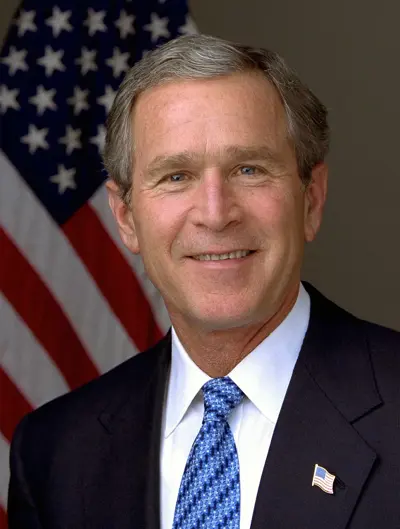
George Walker Bush is an American politician and businessman who served as the 43rd president of the United States from 2001 to 2009. A member of the Republican Party, Bush previously served as the 46th governor of Texas from 1995 to 2000. He was born into the Bush family; his father, George H. W. Bush, was the 41st president of the United States from 1989 to 1993.
