William Tecumseh Sherman Quotes
Everybody was talking of “Gold! gold!!” until it assumed the character of a fever. Some of our soldiers began to desert; citizens were fitting out trains of wagons and pack-mules to go to the mines. We heard of men earning fifty, five hundred, and thousands of dollars per day, and for a time it seemed as though somebody would reach solid gold. Some of this gold began to come to Yerba Buena [San Francisco] in trade, to disturb the value of merchandise, particularly of mules, horses, tin pans, and articles used in mining.
Sherman then was a young officer assigned to the military command in California.
William Tecumseh Sherman, 1820-1891, General of the Army, Description of the Gold Rush in California of 1848
Sourced by: Eigen's Political and Historical Quotations


It was on his land that the first California Gold was discovered. In one of the great ironies, the California Star stopped publishing 4 days later. The staff had all run off to try and find gold.

This was the first Eastern Report of what was to become the “California Gold Rush.” The story was not thought important enough for the first page.
Most of us think the California was not a slave state, but in the early 1850s the California law (such as it was) allowed a slave owner to “sojourn” in California with his property that could include slaves. A number of Southern save owners took slaves to the California gold fields to do mining. There was a great deal of resentment on the part of the other miners and the free labor of the territory. In 1855, slavery in California was abolished.

Samuel Langhorne Clemens, 1835-1910


The discovery started a white frenzy to prospect the Black Hills. The trouble was that the 1868 Treaty of Fort Laramie had guaranteed the Black Hills to the Lakota Sioux. The Army tried to keep the white gold seekers out, but it was too difficult and there was not great public support for honoring the treaty. So the army decided to buy the Black Hills from the Indians and open it to legal prospecting. But the Sioux refused to sell not wanting to trade their sacred land for money and having no interest in gold. So the whites broke the treaty and took the gold anyway. This led to the hostilities and the greatest Indian victory wiping out Custer and his men at the Battle of the Little Big Horn.


Note the perception of Davis, typical of Southerners at the time, that Southerners were being excluded from California. The logic was this: California had many opportunities in land, gold, and other natural resources. Since California had a Constitutional provision against slavery, no Southerner could enter the new state with his slaves without fear of their being set free. If Southerners bought land or wanted to hunt for gold, they could not bring their slaves to do the heavy work. Therefore, they were excluded from the economic growth of the state. The idea of the whites doing the heavy work themselves of traveling without their family slaves was so foreign to the aristocratic planter class, that it was never considered by them as a possibility. Therefore, they were excluded. However, many of the lower class Southerners of all races saw great opportunities in California where they could compete on an equal footing even though they had no slaves or land.

Prior, the Military, worked hard to enforce the Fort Laramie Treaty which gave the Lakota Sioux Indian Tribe exclusive use of the Black Hills. Bu then gold was accidentally found in the Black Hills and white miners started to illegally enter the Lakota territory. Many of them killed Indians that they ran across. See Quotation 643700. President Grant, under huge political pressure instructed General Sheridan to stop enforcing the provisions of the treaty and keep the whites out of the Black Hills. They idea was to allow the miners to clash with the Lakota who would likely defend their sacred land, and when some whites had been killed, send the army in to “pacify” the Indians and use that as a means of relegation of the Treaty so the the gold areas would bee legally accessible.


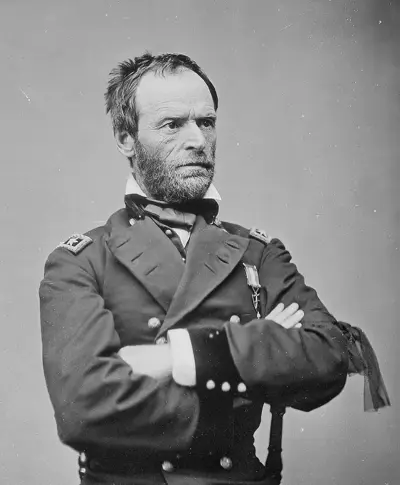
William Tecumseh Sherman was an American soldier, businessman, educator, and author. He served as a general in the Union Army during the American Civil War (1861–1865), receiving recognition for his command of military strategy as well as criticism for the harshness of the scorched earth policies he implemented in conducting total war against the Confederate States. British military theorist and historian B. H. Liddell Hart declared that Sherman was "the first modern general".
