New York Herald Quotes
INTERESTING FROM CALIFORNIA—We have received some late and interesting intelligence from California. It is to the 1st of July. Owing to the crowded state of our columns, we are obliged to omit our correspondence. It relates to the important discovery of a very valuable gold mine. We have received a specimen of the gold.
This was the first Eastern Report of what was to become the “California Gold Rush.” The story was not thought important enough for the first page.
New York Herald, September 15, 1848
Sourced by: Eigen's Political and Historical Quotations


Sherman then was a young officer assigned to the military command in California.

It was on his land that the first California Gold was discovered. In one of the great ironies, the California Star stopped publishing 4 days later. The staff had all run off to try and find gold.


The discovery started a white frenzy to prospect the Black Hills. The trouble was that the 1868 Treaty of Fort Laramie had guaranteed the Black Hills to the Lakota Sioux. The Army tried to keep the white gold seekers out, but it was too difficult and there was not great public support for honoring the treaty. So the army decided to buy the Black Hills from the Indians and open it to legal prospecting. But the Sioux refused to sell not wanting to trade their sacred land for money and having no interest in gold. So the whites broke the treaty and took the gold anyway. This led to the hostilities and the greatest Indian victory wiping out Custer and his men at the Battle of the Little Big Horn.
Most of us think the California was not a slave state, but in the early 1850s the California law (such as it was) allowed a slave owner to “sojourn” in California with his property that could include slaves. A number of Southern save owners took slaves to the California gold fields to do mining. There was a great deal of resentment on the part of the other miners and the free labor of the territory. In 1855, slavery in California was abolished.


Samuel Langhorne Clemens, 1835-1910


Note the perception of Davis, typical of Southerners at the time, that Southerners were being excluded from California. The logic was this: California had many opportunities in land, gold, and other natural resources. Since California had a Constitutional provision against slavery, no Southerner could enter the new state with his slaves without fear of their being set free. If Southerners bought land or wanted to hunt for gold, they could not bring their slaves to do the heavy work. Therefore, they were excluded from the economic growth of the state. The idea of the whites doing the heavy work themselves of traveling without their family slaves was so foreign to the aristocratic planter class, that it was never considered by them as a possibility. Therefore, they were excluded. However, many of the lower class Southerners of all races saw great opportunities in California where they could compete on an equal footing even though they had no slaves or land.
Catledge came to California to cover the gubernatorial race between incumbent Republican Governor Merriam and writer Upton Sinclair, an avowed socialist who was running neck and neck. Palmer was then the Political Editor of the Los Angeles Times and his newspaper never covered anything Sinclair did for the campaign and only covered Merriam. Catledge observed that this was not only unfair but poor journalism.
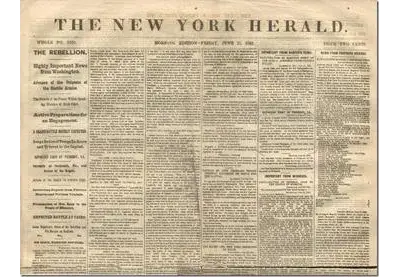
The New York Herald was a large-distribution newspaper based in New York City that existed between 1835 and 1924, when it was acquired by its smaller rival the New-York Tribune to form the New York Herald Tribune.
