Ernest Renan Quotes
Every rebel is, with us, more or less a soldier who has missed his vocation, a being made for a heroic life ... The European race is a race of masters and soldiers. If you reduce this noble race to the work in a slave's prison like Negroes or Chinamen, it will rebel.
Renan, Ernest. La Réforme intellectuelle et morale. Michel Lévy Frères, 1871, p. 92.


See {625675}, {625686}, {625684}, {625683}, {625676} for additional quotations arguing for Black emigration.


Charleston was in the Southern part of the state where most people supported slavery. Douglas made an unequivocal pitch for the racist vote {600060} and forced Lincoln to take a stand. Like many politicians today, Lincoln decided to give the audience what they wanted to hear. It is not clear whether or not he ever believed this statement or was just pandering in a political campaign. He had never said this in the Northern part of the state of before. Lincoln’s views on race changed and matured over the years, culminating in the Emancipation Proclamation. Lincoln lost the Senate seat to Douglas.

In 1831 a slave preacher, Nat Turner, led a rebellion in North Carolina killing over 50 whites. Even though Turner and the rebels were captured and executed, whites throughout the South, took vengeance on any slaves they could find. This description was of a North Carolina community.

The racial inequality did cause a Black revolution in the 1960s. The arrival and influence of Martin Luther King, at the time Black revolution might have turned violent, and the willingness of a substantial number of whites to implement the Civil Rights revolution functioned as a safety valve so that there was substantial reform towards much more racial equality.

This was the first of the famous Lincoln-Douglas Debates. The men were contesting for the U. S. Senate. Douglas won the election.


In 1831 a slave preacher, Nat Turner, led a rebellion in North Carolina killing over 50 white men, women and children. Even though Turner and the rebels were captured and executed, whites throughout the South, took vengeance on any slaves they could find.
The reason for the initial total killing policy was that the slaves had no arms. Their plan was for a small band to attack a plantation, seize the owner’s arms, free his slaves enlarging the “army”, and going on to the next plantation. The reason for the total killing of the whites was to prevent a survivor running to the authorities and mounting a counter attack on the slaves while they still had few guns. The plan was to form an armed slave army and then fight a conventional battle. Ironically, one white who was wounded and spared actually did reach the authorities and Turner’s band was attacked before they had sufficient weapons to put up a serious fight.

See {630997} for the description of the terror policy.

This fear was great among many who were abolitionists as potentially there might be mass slaughter of all Southern whites.

Butler was at the time the Union general in charge of Louisiana. He had on his hand a large group of slaves whose owners had abandoned the area. There was no emancipation yet. He wrote for instructions. The result was the first actual emancipation of slaves.

There was a huge amount of racial interbreeding during the early slavery times of America. Some was consensual as people will be people, but much was the rape of Black slaves my white masters—a concept that was never considered rape by law as one cannot commit a crime against one’s own property. The result after time was every possible combination of white/black mixture. There were names for many of the combinations: Quadroons were one fourth Negro. Octaroons, one-eighth. During and after reconstruction, for purposes of discriminatory law, who was a Negro? The Louisiana “one drop rule” said that if there was ANY trace of Negro ancestry, that person was a Negro and would be discriminated against. Of course, what would happen was that many mixed race children were light skinned and looked white and many were black and all shades in between. It was relatively easy for the lighter skinned “one drop” Negroes to pass as white especially if the left the state. But if anyone accused them of being Negro, they would have been guilty of committing crimes. Some in modern times have little comprehension of how the white plantation slave owners and other whitrd could condemn their own children to a second class life of vicious discrimination, but that is exactly what they did. The great irony here lies with the modern KKK, Nazi, and other White Supremacy Groups. They still hold to the “one drip rule for their viciousness. However, under the one drop rule, almost all of them would be Negroes if they went back far enough, and ALL ARE BLACK under the one drop rule as with modern DNA and genetic analysis, we now know that every human alive today emanated from a Black woman in Africa.

This classic quotation illustrates several things. First, the degree of racism that existed in 1944 in West Virginia. Second, not how young Robert Byrd immediately leaped from the possibility of integrating our fighting forces to interracial sex. That has been typical of white racism in America—a preoccupation with race and sex. Last, Byrd who became a member of the KKK, completely changed his mind over the year and ended up supporting the things that, as a youth were worse than the demise of the nation. He matured and grew on the race issue as much of the country did and ended as a strong supporter of equality and civil rights—including affirmative action.


This was one of the several early unofficial Emancipations that was issued in the Civil War.
This was America’s first emancipation of slaves. It was not done so much for the principle of equality or rights of slaves, but as an intimidation technique applied to the rebellious Americans.


His fear was well founded. That is exactly what the British tried to do.
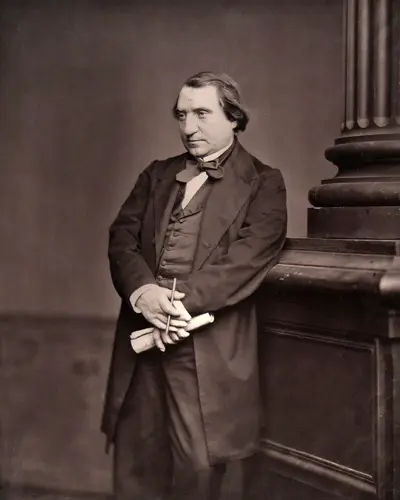
Joseph Ernest Renan was a French Orientalist and Semitic scholar, expert of Semitic languages and civilizations, historian of religion, philologist, philosopher, biblical scholar and critic. He wrote influential and pioneering historical works on the origins of early Christianity, and espoused popular political theories especially concerning nationalism and national identity. Renan is credited as being among the first scholars to advance the now-discredited Khazar theory, which held that Ashkenazi Jews were descendants of the Khazars, Turkic peoples who had adopted Jewish religion and migrated to Western Europe following the collapse of their khanate.
