Richmond Enquirer Quotes
Indiscriminate massacre was not their intention, after they obtained foothold, and was resorted to in the first instance to strike terror and alarm. Women and children would afterwards have been spared, and men also who ceased to resist
See {630997} for the description of the terror policy.
Richmond Enquirer, Editorial on the Nat Turner Rebellion, 1831
Sourced by: Eigen's Political and Historical Quotations

In 1831 a slave preacher, Nat Turner, led a rebellion in North Carolina killing over 50 white men, women and children. Even though Turner and the rebels were captured and executed, whites throughout the South, took vengeance on any slaves they could find.
The reason for the initial total killing policy was that the slaves had no arms. Their plan was for a small band to attack a plantation, seize the owner’s arms, free his slaves enlarging the “army”, and going on to the next plantation. The reason for the total killing of the whites was to prevent a survivor running to the authorities and mounting a counter attack on the slaves while they still had few guns. The plan was to form an armed slave army and then fight a conventional battle. Ironically, one white who was wounded and spared actually did reach the authorities and Turner’s band was attacked before they had sufficient weapons to put up a serious fight.


Lev Davidovich Bronstein

Knight led a band of whites and blacks who fought off the Confederate Troops sent to Jones County of Missisippi, to eleminate the Free State of Jones which tehy had set up, and seceded from the Confederacy. They had infuriated teh Confederate Government becasue it was an interracial community with a great deal of intermarriage and no discrimination agaisnt Blacks and they welcomed runaway slaves and white deserters from the Confederate Army.

It is not known what actually happened thereafter. However, from the intensity of this letter, it is likely that unless Rice was killed or wounded in battle, he went to get his daughter and deal with her “owner”. An interesting side note is that the slave owner actually sent the letter to the Commanding Union General Rosecrans complaining. The mental set of Southern Slave Owners was incredible to us today, but that is one of the reasons that Reconstruction was so difficult. Southerners could not see anything that they did that was wrong. Unfortunately, there are a few racist people with those views still in America plus many throughout the world.

The racial inequality did cause a Black revolution in the 1960s. The arrival and influence of Martin Luther King, at the time Black revolution might have turned violent, and the willingness of a substantial number of whites to implement the Civil Rights revolution functioned as a safety valve so that there was substantial reform towards much more racial equality.


This fear was great among many who were abolitionists as potentially there might be mass slaughter of all Southern whites.

Butler was at the time the Union general in charge of Louisiana. He had on his hand a large group of slaves whose owners had abandoned the area. There was no emancipation yet. He wrote for instructions. The result was the first actual emancipation of slaves.

This was one of the several early unofficial Emancipations that was issued in the Civil War.

His fear was well founded. That is exactly what the British tried to do.


She was one of the early abolitionists. Despite the Southern attempted repression of information of slave resistance, some of the facts emerged and were well known in the North. The South tried to suppress these incidents lest other slaves get ideas from it. Also the Southerners often maintained that Africa was so primitive and underdeveloped, that the slaves were better off in America; these actions of rebellion belied this notion.

The point about the negroes who were born into American slavery being less aggressive than those captured and transported to America is often overlooked. Slavery not only was cruel, moral, and inhuman in its own right, but also took its toll over generations as a result of the psychological effects of the terror of slavery. Despite these, it is amazing how resiliant the American Blacks were under those circumstances. in some cases one or two saves escaped after committing a violent act as they had little to lose for trying as they wold be killed if caught. A few of these escaped to the North and others reached Southern Cities like Charleston where there was a small free black community in which they could be absorbed.

The White Boers viewed themselves as superior to the Blacks and the Blacks and Whites competed for land. In an early form of ethnic cleansing, the Boers attacked the undefended women and children of the Black tribes. The authorities opposed these atrocities but did not have any way of enforcing their orders.

Eldest son of Robert Walpole. Lord Dunmore, royal governor of Virginia, had issued a proclamation offering freedom to slaves willing to defend the Crown

He was also himself a ship owner in the slave trade and he was the brother of the leading Rhode Island abolitionist, Moses Brown. See {585793}. Brown became the first American, prosecuted in federal court for illegal slave trading –-- a prosecution brought, in part, by his own brother. He was, however, acquitted.

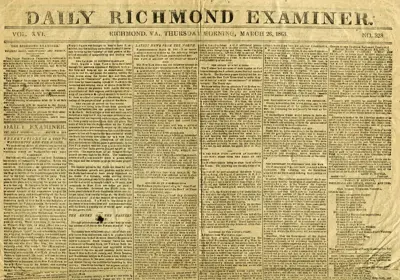
The Richmond Examiner, a newspaper which was published before and during the American Civil War under the masthead of Daily Richmond Examiner, was one of the newspapers published in the Confederate capital of Richmond. Its editors viewed strong executive leadership as a threat to the liberties of its subscription readership. The paper published staunch and increasingly vitriolic opposition to the leadership and policies of Confederate President Jefferson Davis. Historians often consult the pages of the Examiner for insights into the growing problems faced by the Davis administration and the South as they faced the increasing prospect of defeat in the Civil War.
