Hu Jintao Quotes
Development is the foundation of resolving Tibet’s problem.
The great challenge is trying to develop and modernize a culture that does not want to be modernized at the moment but still wants many of the benefits of modernization.
Hu Jintao, President of China, Speech 2006
Sourced by: Eigen's Political and Historical Quotations

Although the Premier recognizes the importance of environmental protection it is difficult for China and other developing countries to make the necessary trade off’s at the expense of slower growth which means continued poverty. Even in the United States with all its affluence, slowing economic growth for environmental reasons is politically very difficult.

Some Tibetans believe that the Han Chinese will indeed develop the area, but will in the process change the nature of the area and its culture—that the Han culture will dominate just as initially minority cultures have dominated and transformed South Africa, India, Canada and even the United States. Of course, modernization per se changes a culture radically.

Tibet and some other ethnic enclaves of China have been almost impervious to the general improvement in the standard of living that China accomplished at the end of the 20th century and beginning of the 21st. China is not the only nation to have this difficulty. Some would argue that America still has it with some of its Native American nations. The great challenge is trying to develop and modernize a culture that does not want to be modernized at the moment but still wants many of the benefits of modernization.

While the American Civil War was raging, Pinyin Hong Xiuquan started a quasi Christian religion (he claimed to be the brother of Jesus Christ) in China which initiated a war of extermination with the Manchus and other religions. More than 20 million Chinese were killed in a religious war that proportionately killed more Chinese than the Nazis killed in Europeans. Though hardly noticed in America and Europe, the religious war of extermination had been so traumatic that dissident religions are the most feared problem by Chinese modern leaders—more so than Capitalists, Taiwan or any of the modern ‘enemies’. It is the Falun Gong and the Tibetan Buddhists who the leadership fear might grow into another Yellow Turban movement—the worst Trauma of Chinese History—even worse than the Japanese WWII invasion. Hence the irrational view of the Chinese leadership towards religions they cannot control. See {612649} and {612649}. In Western terms as Wiesel put it, the Chinese leadership suppression of Tibet makes little or no sense, but current Chinese leadership is paranoid as a result of its history.


Europe was still suffering from the economic effects of the Great Recession.


This was an incredible prediction that few people thought was possible. This speech was given in the early days of WWII when it was far from clear that we would win.


This surprising quotation, along with others a far from main steam American views (See {623830} ) assured her election defeat.


Although both of his historical African successes have been successful, most of the leaders argue that the vestige of colonialism was the biggest obstacle and but for the colonial history, they would be much further ahead than they are.


Brazil and Chile are getting close, but his predictions are still in the future.
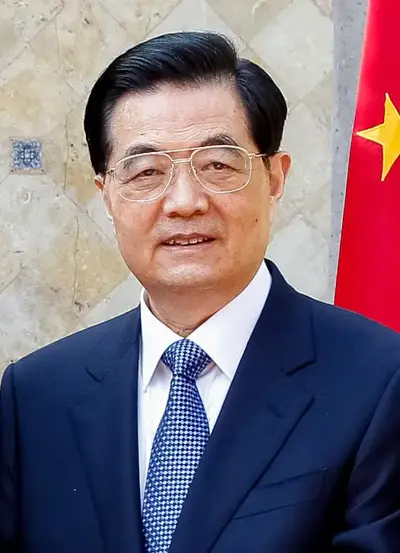
Hu Jintao is a Chinese politician, who was General Secretary of the Chinese Communist Party (CCP) from 2002 to 2012, President of the People's Republic of China (PRC) from 2003 to 2013 and Chairman of the Central Military Commission (CMC) from 2004 to 2012. He was a member of the CCP Politburo Standing Committee, China's de facto top decision-making body, from 1992 to 2012. Hu is considered to have been the paramount leader of China from 2004 to 2012.
