Martin Luther Quotes
But what will happen even if we do burn down the Jews synagogues and forbid them publicly to praise God, to pray, to teach, to utter God's name? They will still keep doing it in secret. If we know that they are doing this in secret, it is the same as if they were doing it publicly. for our knowledge of their secret doings and our toleration of them implies that they are not secret after all and thus our conscience is encumbered with it before God.
Luther, Martin. Luther's Works, Vol. 47: The Christian in Society IV. Edited by Franklin Sherman, Fortress Press, 1971, p. 285.


At first this clause appears to be very enlightened and establishing freedom of conscience. This clause allowed Catholics to practice freely whereas in other colonies they could not. However, as one reads on, it becomes clear that the “tolerance” is limited to Christians only. Then if one examines the exception within the parentheses and refer to the rest of the act—see {611994}—, one finds that even Christians who have certain theological beliefs are to be put to death—those for example who deny the holiness of the Trinity such as Unitarians who were a major group in the New England Colonies. It was a significant step at the time however to protect Roman Catholics.


This appears to be one of the first religious groups to withdraw and separate from a state church.


Catholics were blamed by some for the defeat of Henry Clay in 1844. Anti catholic sentiment was high:. Johnson was then a Congressman representing a district where there were few Catholics and strong anti-Catholic feeling.

This is the first American ordinance of freedom of conscience. Note that it only provided freedom of religion for Christians. However, that was an important first step as different sects of Christianity had been persecuting each other whenever the opportunity arose.

The first Jewish Publication in the United States


This law governed the territories outside of the original 13 colonies. This is the first chance that Congress had to legislate on religious freedom, and they guaranteed that there would be no territory that would be founded by or unilaterally controlled by any particular religion at the expense of the religious freedom of other people.

This quotation is an excellent summary of view of most fundamentalist Muslims’ current views towards Christians and Jews. In the Koran, the Prophet made exceptions about required conversions to Islam for Jews, Christians, and Zoroastrians (the pre Islamic Iranian religion). However, although they were to be allowed to maintain their religion. They had to pay a special tax called “Jizya” described in the quotation. Islam interpreted these words of the Prophet very differently in different places and times. Jews and Christians were not only treated very well in Islamic Spain and in Ottoman Turkey when Turkey was the seat of Islamic religion and power in the world, but they achieved some of the most important positions of power in the Empire and in the professions: law, military, teaching, philosophy, science and medicine. However, in other times and places, non Muslims were not allowed to worship in public or hold any position of influence or power and certainly never teach Muslims. So Jews and Christians in this world view will be tolerated but they must exist under a Muslim theocracy. That is the view that most of the ultra fundamentalist Muslims have today, which of course sets up a serious conflict potential.

Henry of Navarre
By the beginning of the 21st Century, some Republicans had perfected the art of naming legislation completely contrary to its intent and effect in order to make opposition to it more difficult for opponents in the legislature. But nothing they ever did came close to the audacity of naming this legislation, The Toleration Act, as it was about the most intolerant legislation ever passed in America. Exactly what the motivation of the legislative drafters was is not known. One theory is that as a Catholic Colony, perhaps they really thought that they were being tolerant as they would not execute Protestants except Unitarians. In any event is was a low point in American history and was one of the examples that was before the Founding Fathers when they added the First Amendment to the Constitution. See {624142} for the text.

Roger Williams, the founder of Rhode Island had provided in its charter for freedom of conscience. See {624148}. However later the Colonial legislature withdrew the franchise from Roman Catholics. Despite this temporary restriction of religions freedom, Rhode Island and Connecticut were far ahead of the other New England colonies in freedom of conscience.


William was a Catholic himself. Spain then controlled Holland.


Abdul Rahman, Afghan citizen, had converted from Islam to Christianity 16 years before. Conversion from Islam is a capital crime under Sharia Law which was the law of Afghanistan even after the Taliban had been overthrown. He was jailed and threatened with death. Statements like this and others made directly to the government persuaded the Afghan politicians to go against their mullahs who demanded the death penalty as is proscribed by Islamic Law—Sharia. The judges tried to get Rahman to recant and he would not (see {589518}). So they finally decided that he must be mentally insane and therefore could not be tried, and the problem was solved that way.
Williams was the first theologian who not only advocated religious toleration but argued that Christianity demanded it and the separation of church and state.

New Ross was under siege by Cromwell and his English Parliamentarian troops. After two days, the town tried to negotiate terms of surrender and one of the main things they asked for was freedom of religion to practice Roman Catholicism. This famous response set the stage for religious bigotry over the next years. Cromwell’s reasons for not allowing Catholicism to be practiced was not only one of religious zeal. At the time, the Roman Catholic Church was a major geopolitical power under a Pope who commonly supported or even dispatched troops for geopolitical and religious ends. The Vatican was particularly resentful of England for separating from the Church and asserting that the King of England was the head of the Church and not the Pope. Therefore Cromwell and many Englishmen had to deal with the reality that every practicing Catholic in the realm was a potential spy, traitor, and/or rebel. This fear of control of countries by the Pope strongly affected America, and was responsible for the defeat of the first Catholic Presidential Candidate, Al Smith. It was also a major factor in the election of John F. Kennedy so he dealt with it head on.

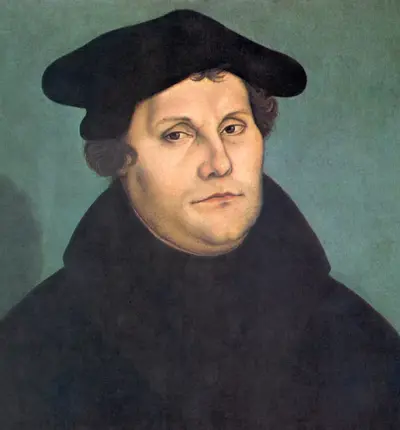
Martin Luther, O.S.A. was a German professor of theology, priest, author, composer, Augustinian monk, and a seminal figure in the Reformation. Luther was ordained to the priesthood in 1507. He came to reject several teachings and practices of the Roman Catholic Church; in particular, he disputed the view on indulgences. Luther proposed an academic discussion of the practice and efficacy of indulgences in his Ninety-five Theses of 1517. His refusal to renounce all of his writings at the demand of Pope Leo X in 1520 and the Holy Roman Emperor Charles V at the Diet of Worms in 1521 resulted in his excommunication by the pope and condemnation as an outlaw by the Holy Roman Emperor.
