Galerius Quotes
We therefore ... are pleased to grant indulgence to these men, allowing Christians the right to exist again and set up their places of worship; provided always that they do not offend against public order. In return ... it will be the duty of Christians to pray to God for our recovery [and] ... that the state may be preserved from danger.
Galerius, ?-311, Roman Emperor, Edict from his death bed, 311
Sourced by: Eigen's Political and Historical Quotations


This was the beginning of the inquisition.


Henry of Navarre

He is a Greek Orthodox Christian, and he correctly observes that the Islamic world was considerably more tolerant than the Christian until the 18th century when Islam had become less tolerant in the Middle East while the Christians were modernizing and going through a cultural and intellectual enlightenment and societal modernization while the Muslims, became less tolerant than they were in earlier years leading to the modern situation.


This was the second liberal constitution in the world following on the heels of United States Constitution upon which some of this constitution is based. See {585394}. This particular clause is noteworthy for its internal contradiction regarding freedom of religion. After making it illegal to convert any Catholic to any other religion, the constitution goes on to establish freedom of religion. So one was guaranteed the right to practice one’s own religion but if the religion advocated evangelizing and converting others, that part of religious freedom was banned when targeting Roman Catholics.
His protest was focused on Middle East policies which he believed did not value the lives of Muslims as highly as Christians and Jews. The irony of this protest is that United States policy claims to value all life equally as do virtually all industrialized democracies. Omeish however is unusual among world Islamic leaders and politicians in that he values Christian and Jewish life as much as Muslim. Most, typically value Muslims almost exclusively and many advocate the killing of Christians and Jews.
This book is endorsed by major religious organizations of all faiths as well as National School Boards Association, National Education Association, National PTA, National Association of Secondary School Principals, National Association of Elementary School Principals, American Association of School Administrators and others. It is used as a guideline by most schools systems in the United States.


Catholics were blamed by some for the defeat of Henry Clay in 1844. Anti catholic sentiment was high:. Johnson was then a Congressman representing a district where there were few Catholics and strong anti-Catholic feeling.


At first this clause appears to be very enlightened and establishing freedom of conscience. This clause allowed Catholics to practice freely whereas in other colonies they could not. However, as one reads on, it becomes clear that the “tolerance” is limited to Christians only. Then if one examines the exception within the parentheses and refer to the rest of the act—see {611994}—, one finds that even Christians who have certain theological beliefs are to be put to death—those for example who deny the holiness of the Trinity such as Unitarians who were a major group in the New England Colonies. It was a significant step at the time however to protect Roman Catholics.

Those who claim that the founding fathers contemplated religion as a critical component of government often point to this article of the South Carolina Constitution. However, they ignore the almost simultaneous passage of the New York constitution as in {612166}. When the framers of the Constitution met in 1787 in Philadelphia the separation of church and state issue was not really resolved and awaited the Bill of Rights where the separatists won out.
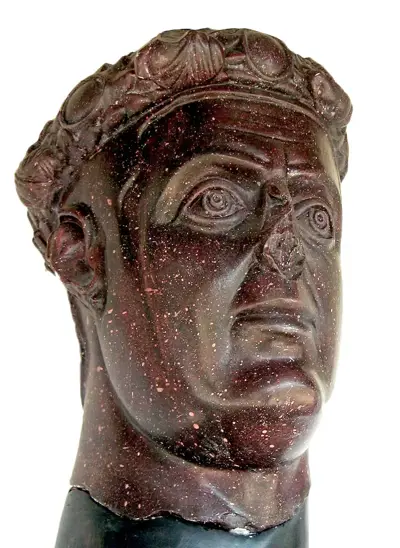
Galerius was Roman emperor from 305 to 311. During his reign he campaigned, aided by Diocletian, against the Sassanid Empire, sacking their capital Ctesiphon in 299. He also campaigned across the Danube against the Carpi, defeating them in 297 and 300. Although he was a staunch opponent of Christianity, Galerius ended the Diocletianic Persecution when he issued an Edict of Toleration in Serdica in 311.
