John Stuart Mill Quotes
Before the time of the conquest, the Irish people knew nothing of absolute property in land. The land belonged to the entire sept; the chief was Little more than the managing member of the association. The feudal idea which came in with the conquest was associated with foreign dominion, and has never to this day been recognized by the moral sentiment of the people
John Stuart Mill, 1806-1873, Member of Parliament, British Political Economist, Quoted in James Connolly, Erin’s Hope: The End and the Means, 1897
Sourced by: Eigen's Political and Historical Quotations

At the time the number of small, independent land owners was diminishing.


This was the basic document issued after the Russian Revolution establishing the basic legal and economic structure of the new Soviet State.

Primogeniture is the system where property is inherited from the father to the first born son. At the time women could not own property unless they were widows. It is the basis of most aristocracies. See {627010} for an American view of primogeniture that was stated a little earlier.


Manava Dharma Shastra. This legal principle is operative in every one of the United States to this day, the only difference being a longer period of time. This text is a part of the Hindu Holy Texts. Hindus believe that Manu was a prophet whose text is revealed or inspired.


Use included renting it. What he opposed was simply holding land when whites were driving Indians off their lands because all the unused land outside of the reservation was owned by someone and the asking price was very high. Ingersoll was considered to be the greatest orator and political thinker of his day, but his overt atheistic views curtailed his elected political career.


The Romans were very organized regarding land ownership. When they conquered Africa, defeating Carthage, they found no written records of land ownership, no deeds, no bills of sale. Therefore, they opened up the entire land mass of Africa for what amounted to public colonization where the land could be worked and claimed legally. Illiterate Africans had no written records, and most areas where under the control of a strongman who “owned” all of the land with no notion of private ownership of land.

Earlier, treaties had been negotiated whereby whites purchased certain Indian lands. Tecumseh and others had objected not only to the concept of land sale, but to those who had sold the lands {612650}.

Theoretically, this decree would have provided a fair amount of economic freedom for communist Russia. This decree gave some degree of comfort to the Western Europe and America, but had some major opponents within world communism who thought it too capitalistic. In practice the rights were never really available and this was one of the many “principles” of Soviet Communism which may have sounded reasonable but were never allowed to function in practice. Within a few years even the pretense of these principles was dropped.


The Diggers were a religious-economic movement that even today would be considered very radical. They advocated the right of the poor to go onto public lands and farm them—thus the name “Diggers.” Beyond their opposition to the private ownership of land to the exclusion of the poor, Winstanley and the Diggers promulgated another very modern doctrine: That the poor should take the responsibility and have the right to determinine how the society should provide for the poor. A version of this became one of the Mottos of the Poverty Program of 1964. See {616966}.
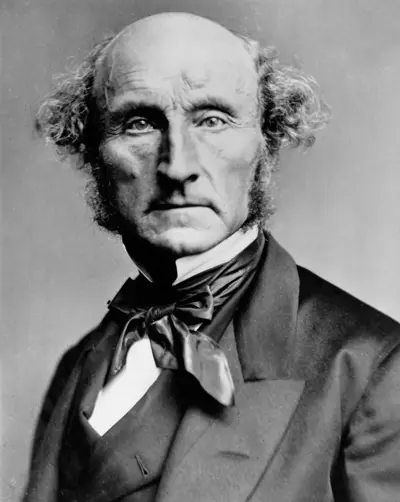
John Stuart Mill, usually cited as J. S. Mill, was an English philosopher, political economist, Member of Parliament, and civil servant. One of the most influential thinkers in the history of classical liberalism, he contributed widely to social theory, political theory, and political economy. Dubbed "the most influential English-speaking philosopher of the nineteenth century", he conceived of liberty as justifying the freedom of the individual in opposition to unlimited state and social control.
