Adam Smith Quotes
…primogeniture was founded upon the most absurd of all suppositions, the supposition that every successive generation of men have not an equal right to the earth, and to all that it possesses; but that the property of the present generation should be restrained and regulated according to the fancy of those who died perhaps five hundred years ago.
Primogeniture is the system where property is inherited from the father to the first born son. At the time women could not own property unless they were widows. It is the basis of most aristocracies. See {627010} for an American view of primogeniture that was stated a little earlier.
Adam Smith, 1723-1790, Scottish Political Economist, Inquiry into the Nature and Causes of the Wealth of Nations, 1776
Sourced by: Eigen's Political and Historical Quotations

See {627027} for an earlier expression of this point.

Muir had spoken at the Convention of Scottish Friends of the People at Edinburgh in 1792. He had advocated election reform allowing all men to vote, not just property owners and was sentenced by Braxfield to the Australian penal colony at Botany Bay. Braxfield expressed the deep distrust the establishment felt even for merchants, traders and others with fungible assets.

This was the basic document issued after the Russian Revolution establishing the basic legal and economic structure of the new Soviet State.

There are many who wish for such a simple adoption procedure today.
In every society where there had been past unjust ownership of land, all efforts of land reform were faced with the problem of having to dispossess the current “owners” who themselves had not been guilty of the crimes of their ancestors in unjustly obtaining the land originally. In America land reform was unworkable in most cases and the solution was usually a large monetary payment as compensation for the land.

A fief was an estate of land and people. The man who had the title to the fief was obligated to raise troops from his estates and lead then at the command of the King. Women, under English law could not inherit a fief—it went to the oldest son. However, once the military element of fiefdom was eliminated, Johnson saw no reason why women should no longer inherit feifs and the titles that went with them.


Even into the 20th Century in some states women could not inherit property if there was a male child.


Theoretically, this decree would have provided a fair amount of economic freedom for communist Russia. This decree gave some degree of comfort to the Western Europe and America, but had some major opponents within world communism who thought it too capitalistic. In practice the rights were never really available and this was one of the many “principles” of Soviet Communism which may have sounded reasonable but were never allowed to function in practice. Within a few years even the pretense of these principles was dropped.


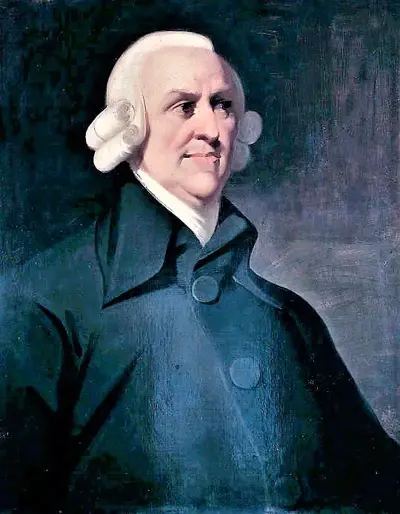
- Born: June 16, 1723
- Died: July 17, 1790
- Nationality: Scottish
- Profession: Economist
Adam Smith FRSA was a Scottish economist, philosopher as well as a moral philosopher, a pioneer of political economy, and a key figure during the Scottish Enlightenment, also known as ''The Father of Economics'' or ''The Father of Capitalism''. Smith wrote two classic works, The Theory of Moral Sentiments (1759) and An Inquiry into the Nature and Causes of the Wealth of Nations (1776). The latter, often abbreviated as The Wealth of Nations, is considered his magnum opus and the first modern work of economics. In his work, Adam Smith introduced his theory of absolute advantage.
