John Locke Quotes
All wealth is the product of labor.


The factory workers in Lynn, Massachusetts started their own newspaper: This was published four years before Marx and Engles published the Communist Manifesto


This used to be a generally accepted principle in America. It took labor to produce wealth. It could be someone else’s labor or even slave labor, but labor produced things or labor enabled us to find minerals like gold or oil. However, in modern capitalism, money itself can produce wealth by investing or yielding interest. Inventions produce wealth as do other ideas. Authors and movie producers produce wealth. Who you know can produce wealth (finder’s fees) as can knowledge.


Niles, a Southern editor was none the less anti-slavery. Other than the gross immorality of slavery, he saw that the economics of the institution actually inhibited the economic development of the South very early. Efficiency of machinery and organization of work and labor saving inventions were not as badly needed in a slave economy where human labor was so inexpensive. While in the North and most of Europe, there was skilled, but expensive, labor of freemen. This motivated all to improve processes and technology and increase productivity. There was much less motivation in the South and the slaves who actually understood the work had no way to experiment and were not allowed to read or write so the South was almost economically and technologically stagnant in comparison to the free labor states.


Ten cents a day was a very low wage—it was about the equivalent of a meal at a tavern at the time. Workers throughout the country were outraged and give him a derogatory nickname—see Quotation 643585.

This was an honest theoretical belief of Mises. However, most of the criticism of capitalism in the industrial democracies is precisely the lack of unemployment and sustenance for all. When it does, even complaints about inequality tend to be minimal. But some capitalist societies never provided these, and by the 21st century, no capitalist nation was able to do so permanently without recessions and depressions.


Labor unions as we know them did not then exist. Calhoun and many others saw the struggle as a inherent class struggle, not unlike that particular view of Karl Marx. See {606584} for one his more extreme views on the subject.


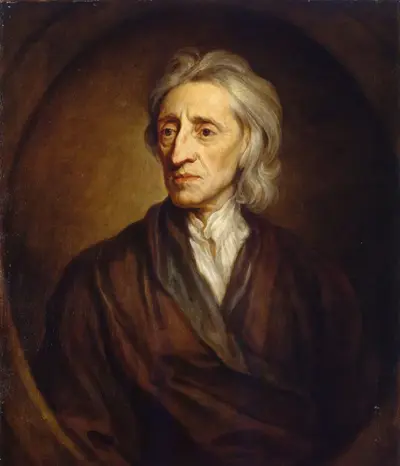
John Locke FRS was an English philosopher and physician, widely regarded as one of the most influential of Enlightenment thinkers and commonly known as the "Father of Liberalism". Considered one of the first of the British empiricists, following the tradition of Sir Francis Bacon, Locke is equally important to social contract theory. His work greatly affected the development of epistemology and political philosophy. His writings influenced Voltaire and Jean-Jacques Rousseau, and many Scottish Enlightenment thinkers, as well as the American Revolutionaries. His contributions to classical republicanism and liberal theory are reflected in the United States Declaration of Independence.
