Mutsuhito Meiji Quotes
A deliberative assembly should be formed, and all measures be decided by public opinion.
Meiji the Great. “Public Opinion” had the same meaning for the Japanese of this time as modern Western democracies perceive it with one exception. The public did not include all; it included only landlords— who owned land and had peasants on it. However, even asking them was an incredible step forward. The Emperor even sent formal written surveys to the landlords and in that sense, Japanese methodology of ascertaining public opinion was far ahead of the West. These reforms were opposed by the nobility and later the military, and by the 1930s there was no semblance of democracy left in Japan.
Mutsuhito Meiji, 1852-1912, Emperor of Japan Charter Oath, 1868
Sourced by: Eigen's Political and Historical Quotations

Declaration of Humanity. Printed in Japanese Newspapers. Contrast this with the previous Japanese political leadership tradition as {43746}

the power a ruler or a ruling class


This was his version of the governing body of a republican commonwealth. His assumption was that the ablest men would be the nobility, the educated and religious (Catholic) elite.


At the time the power and prestige of Congress relative to the Presidency , was much greater than it is today. It was McKinley’s successor, Theodore Roosevelt, who began a 20th century trend which led to a reversal of the relationship between the Executive Branch and the Legislative.


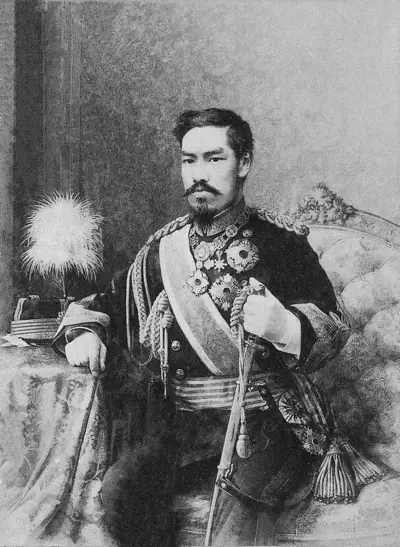
Emperor Meiji, also called Meiji the Great (明治大帝, Meiji-taitei), or Meiji the Good (明治聖帝, Meiji-seitei), was the 122nd Emperor of Japan according to the traditional order of succession, reigning from 3 February 1867 until his death on 30 July 1912, and the first monarch of the Empire of Japan. He presided over the Meiji era, a time of rapid change that witnessed Japan's transformation from an isolationist, feudal state to an industrialized world power.
