Montesquieu Quotes
The great advantage of representatives is their capacity of discussing public affairs. For this, the people collectively are extremely unfit, which is one of the chief inconveniences of a democracy.
Charles de Montesquieu, 1689-1755, French Lawyer, Writer & Political Philosopher, The Spirit of the Laws, XXV, 2, 1748
Sourced by: Eigen's Political and Historical Quotations

Declaration of Humanity. Printed in Japanese Newspapers. Contrast this with the previous Japanese political leadership tradition as {43746}


Meiji the Great. “Public Opinion” had the same meaning for the Japanese of this time as modern Western democracies perceive it with one exception. The public did not include all; it included only landlords— who owned land and had peasants on it. However, even asking them was an incredible step forward. The Emperor even sent formal written surveys to the landlords and in that sense, Japanese methodology of ascertaining public opinion was far ahead of the West. These reforms were opposed by the nobility and later the military, and by the 1930s there was no semblance of democracy left in Japan.


His faction won on the House and lost with respect to the Senate.


Chief legal officer of a Dutch town. He wanted to have a plebiscite in each town on major issues before the assembly so as to instruct the representative as to how to vote. The graphic is a painting of Adriaan van Zeebergh and his board of the Teylers Stichting.


Originally it was published in Boston under the name “A Columbian Patriot.” The “principles to which she referred were the principles set out in our Constitution of 1787.


Speaking then as a congressman:. those of the voters of a particular district
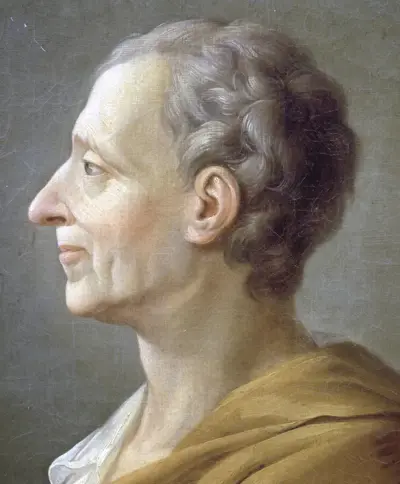
Charles-Louis de Secondat, Baron de La Brède et de Montesquieu, generally referred to as simply Montesquieu, was a French judge, man of letters, and political philosopher.
