Muhammad Ali Jinnah Quotes
You have ruined politics in India by dragging up a whole lot of unwholesome elements in Indian life and giving them political prominence. It is a crime to mix up religion and politics the way you have done.
Jinnah who at later years of his life became a rabid leader and facilitator of religious bigotry and violent Jihad, was totally opposed to mixing religion in politics. His view was so strong on this point that he even criticized Gandhi for mixing religion with politics when he was a sing star of the Indian Congress Party. Jinnah's flip flop on this point led to one of the great massacres and tragedies in human history.
Muhammad Ali Jinnah, 1876-1948, Founder of Pakistan and First Governor General, Statement to Mohandas K. Gandhi, 1869-1948, Quoted in Jaswant Singh, Jinnah: India-Partition-Independence
Sourced by: Eigen's Political and Historical Quotations

In the latter part of the 20th century and the beginning of the 21st century, right wing talk show hosts had extensive conservative audiences who were very susceptible to hyperbole, exaggerations, vitriol, ideology, and conspiracy theories. They in turn pressured the conservative politicians along the lines of the media shows version of conservatism. The result was that the most powerful conservatives in America were media personalities like Rush Limbaugh and Glenn Beck. They had more influence on the Republican party than any of the Republican elected officials. Moyers, used to working with Republicans in many bi-partisan efforts attributed the extreme hyperpartisanship, and nasty, gridlocked political scene that developed in these media personalities.


The Kentucky legislature appropriated over $10 million to the University of the Cumberlands to establish a School of Pharmacy and provide some scholarships thereto. The difficulty was that the University of the Cumberlands was affiliated with the Baptist Church. Simmons, himself a Baptist Minister, was outraged at this violation of Church and State. He appealed to the Kentucky Supreme Court, which unanimously held that the appropriation was un-Constitutional.


The report was praised by some of the intellectuals of Pakistan and most of the non-Islamic world. However, Pakistan the discussion of each of the cleavages, instigated the public passion of the cleavage and nothing significant was done.


Northam, then the Virginia Lieutenant Governor, was campaigning to be the Virginia Governor. President Donald Tump had been in office less than 4 months, but his approval rating was the lowest in the early stages of a Presidential term of any President since such a measue had been made. Most of the hostility toward Trump was based on his personal characteristics, his prevaricationsm, and inconsistency. However, no politican in modern history had run for a high State position by attacking a President with such strong terms. However, many psychologists and psychiatrists also agreed with Northam who was a Physician as well as a politician.


This is an example of the politicization of history. Late in the first millinium Islamic warriors invaded and conquered much of Hindu India. The Muguls controlled much of India for hundreds of years. When the English conquered India, the Muslims rejected Western education and legal systems while the Hindus did not. After several generations the Hindus, better educated, and more sophisticated in Western ways took advantage of the numerical majority and regained control under the British. With Independence, Islamic nationalists insisted upon partition of the country creating a Muslim country, Pakistan. Millions of Indians were murdered in internecine attacks during the partition. Subsequently, Muslim historians have written one version of the history of India, while Hindu historians have written another. They appear to come from different planets or parallel universes. British historians have a third universe.

“Mussalman” was another name for a Muslim. Jinnah was arguing for a separate Muslim state within India. 7 years later he got is wish and Pakistan was born. However many Muslims chose to remain in India even though it was a majority Hindu state. Jinnah was right for many Muslims and wrong for many others who have integrated into Indian society and there is some intermarriage in India, which has 120 million Muslims, almost as many as Pakistan with 160 million.
Jinnah himself preached non-violence. At the time there was vicious sectarian violence throughout India but especially in The Frontier Province. However, the Muslims of the day did not heed him or Nehru or Gandhi for that matter and the violence continued. Jinnah however was a particularly shrewd politician who successfully used the threat of Muslim violence to obtain a separate Islamic state with Indian independence. He pointed to the threatening resolution issued earlier {627153}. The man who publicly preached peace, privately threatened violence.

Arguments against the Partition of India at the time centered around the poor economic viability of a separate Muslim state. However Iqbal and others placed the cultural issues in the forefront. They eventually prevailed.
The Muslim League had whipped up and armed Muslims to fight for a separate Islamic state within India. However, instead of revolt or attacks on the Indian officials, things got out of hand and even after they had won the partition of India, the Muslim mobs went on a frenzy and attacked the Hindus and Sikhs in the areas where the Muslims were in the majority. Part of the reason was to intimidate the Indian and British authorities {627153} and the other part was for ethnic cleansing so when there was a partition—Pakistan—the minority Hindus and Sikhs would have converted, been frightened off, of killed. {627149}. Tragically, Hindus and Sikhs retaliated where they were in the majority and no one really knows how many millions of Indians were butchered in the creation of Pakistan.


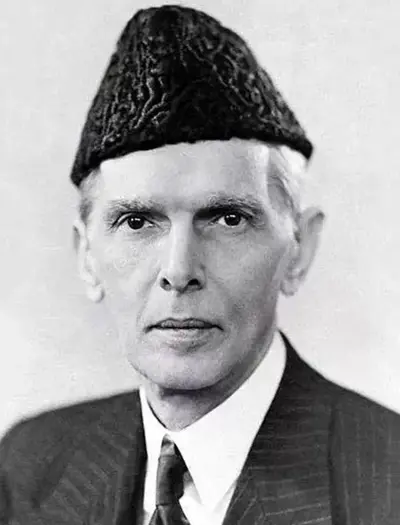
Muhammad Ali Jinnah was a barrister, politician and the founder of Pakistan. Jinnah served as the leader of the All-India Muslim League from 1913 until the inception of Pakistan on 14 August 1947, and then as the Dominion of Pakistan's first Governor-General until his death. He is revered in Pakistan as the Quaid-i-Azam ("Great Leader") and Baba-i-Qaum ("Father of the Nation"). His birthday is observed as a national holiday in Pakistan.
