Mahatma Gandhi Quotes
The seven blunders that human society commits and cause all the violence: wealth without work, pleasure without conscience, knowledge without character, commerce without morality, science without humanity, worship without sacrifice, and politics without principles.
Mohandas K. Gandhi, 1869-1948, Indian Political and Spiritual Leader, a written list given to his departing grandson Arun Gandhi (October 1947), as quoted in Marriot (Spring 1998; p.5)
Sourced by: Eigen's Political and Historical Quotations


In 1877 Wasburn was dropped from the List of Ministers by the Unitarian Church. He had become quite atheistic.

In 1811 Calhoun was a freshman congressman. Congress was considering raising 10,000 men to resist the encroachments of Great Britain. The large cost of the enterprise was preventing the measure from passing. Calhoun objected to considering the cost factor at all:


Ingersoll was considered to be the greatest orator and political thinker of his day, but his overt atheistic views curtailed his elected political career.


What is fascinating about this quotation is that although the head of a religion, Smith was not advocating the kinds of personal lifestyles of his church the way modern religious leaders do, but was concerned with the much larger issues of expansionism, corruption of the courts and judiciary, and land distribution. He was a classic reform candidate in that sense. Smith had written to most of the then likely Presidential candidates of both major parties asking for their position on the Mormons who were facing persecution wherever they went. None of the politicians would make any satisfactory commitments. Smith took Direct Action and became the only major religious official to have run for the Presidency of the United States until Pat Robertson tried and failed in 2000. Smith’s assassination shortly thereafter cut his run for the Presidency short before it made much headway and politically he had no chance to affect the race.


This quotation so impressed Thomas Jefferson that he wrote it in his Commonplace Book.

President Theodore Roosevelt referred to the same groups similarly. See {638453} and {639956}.

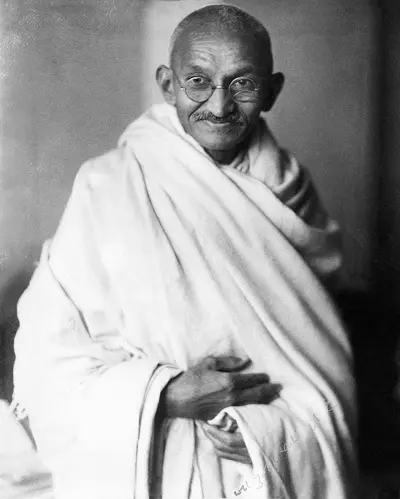
Mohandas Karamchand Gandhi was an Indian lawyer, anti-colonial nationalist, and political ethicist, who employed nonviolent resistance to lead the successful campaign for India's independence from British rule, and in turn inspired movements for civil rights and freedom across the world. The honorific Mahātmā (Sanskrit: "great-souled", "venerable"), first applied to him in 1914 in South Africa, is now used throughout the world.
