Isaac Ingalls Stevens Quotes
Ye old men, ye are my Fathers. You middle aged men you are my brothers. Ye young men, ye are my children. We made a treaty some eighteen months ago. Why did you make it? You believed that there was a good Father across the two oceans, because you believed that he commanded me to make that treaty. Hence I tell you all that I am that Father. I made that treaty. I am glad to meet you today to talk about that treaty and to show you that that treaty shall be respected and that I still feel interested in your welfare. I am sorry that we have trouble and that we have had war. I am glad that the war is now over. We made a treaty and established Reserves at the Nisqually and Puyaloop. Those reservations were suggested by yourselves. I had those reserves surveyed. I found them not good. I sent word to Leshi that those reserves were not good and your brother Col. Simmons told all the Indians that the reserves should be changed. Are the reserves of the Treaty good for you? Or shall we select other reserves? If there be others on which you think you can do better, then your great Father will furnish you one. I shall talk but little more.
Isaac Ingalls Stevens, 1818-1862, First Governor of the Washington Territory, Surveyor, U.S. Coast and Geodetic Survey, Speech to the Fox Island Indians, Tacoma, Washington
Sourced by: Eigen's Political and Historical Quotations

Many American leaders wanted to comply with and enforce the Indian treaties, but the remoteness made it difficult. There were always those whites who did not want to be restricted by Indian treaties who took advantage of the situation when there was a leader like Clinton who wanted to enforce the treaties. However in many cases, the American leadership really did not want to enforce the treaties and in some cases, as with President Andrew Jackson, wanted to abrogate the treaties with the Indians.


There were a few members of Congress who were distressed at the deception that was very often used in negotiations with Indians. They never were a sufficient majority to pass serious, meaningful legislation.


In a tragic irony, the two chiefs were killed by a year later at the Sand Creek Massacre.


In 1877 Gen. O. O. Howard and 600 men fought Chief Joseph and his Nez Perce warriors near Kamiah, Idaho. Outnumbered and outflanked, Chief Joseph headed his band toward the Canadian border, but before they reached it they were captured. Chief Joseph's surrender speech was recorded by General Howard's adjutant: Thunder Rolling Down the Mountain
His negative predictions were tragically prescient.

Clinton was a founder of the society. Many sophisticated Americans were in despair about the consequence of White contact with the Indian, and this was even before the worst of the treatment which came later, beginning under the presidency of Andrew Jackson and continuing well into the 20th century. Of particular interest is Clinton’s prescient observations regarding Africa and Africans interacting with whites with slavery the overriding white motive. Clinton was one of the many Americans who were abolitionists from the beginning of the nation.

“Cleaned out” meant destroyed. He had been a strong advocate of peace with whites. See {610679} .


His Indian Removal Policy forced Native American to leave their lands which were theirs by treaties signed by the United States and marched to the poorest land in Oklahoma where they were "resettled". This is often referred to as the "Trail of Tears". What made his actions evern wors was the fact that The Supreme Court had already ruled that such land belinged to the Cherokee Indian Tribe and the government of the United States may not force them from it. Jackson was the only President in Amrican History to defy a Supreme Court order.

The Barbary Pirates had an incredible extortion racket going in the Mediterranean. If nations would pay them an annual sum each year, they would not attack and seize merchant ships of that country and sell the ships and goods while holding the sailors for ransom. President Jefferson had first dispatched American warships and authorized a major land operation which were very effective. Finally, a treaty was negotiated but Decatur reminded the Navy of what brought the Algerians to the negotiating table.

Indian treaties had legal problems from the beginning of the nation. An agreement had been made at Fort Harmar with 6 Indian nations. One man signed for the United States and several of the sachems, for the Indians. President Washington reported this to the Senate and there was much confusion as to how to proceed. Typically, agents for nations negotiated a treaty but it would not be binding until each ratified it. To the Indians this was not a familiar practice. In this case, the treaty was approved for ratification by the Senate, but what kind of ratification was to be required of the Indians? The Iroquois Indian tribes had formal, methods of reaching consensus, but other nations did not. Whites sometimes reneged on later treaties on the grounds that they were not ratified by the Indian nations. In others, the Indians themselves made the same claim and challenged the right of the Indian treaty signers to speak for the tribe or nation. The problem has never been resolved.

The Indians did not have the wheel when the whites came, but soon there were wagons, stage coaches and railroads.

President Jackson was the most extreme President in terms of abuse of Native American Rights. His racist views and policies were a large reason for the continuing problems that Indians have had gaining fair treatment and equality. Jackson was the only American President who ever refused to obey a Supreme Court decision when he removed the Cherokee Indians from their lands, despite the fact that the Supreme Court had ruled that such a removal was illegal. See {623405} for other Jackson views on Indian policy.
The meeting included several Indians, President Grant, and the Secretary of the Interior and the Director of the Bureau of Indian Affairs. The Indians had been offered $25,000 and land in the Oklahoma Indian Territory in exchange for moving from their traditional lands.


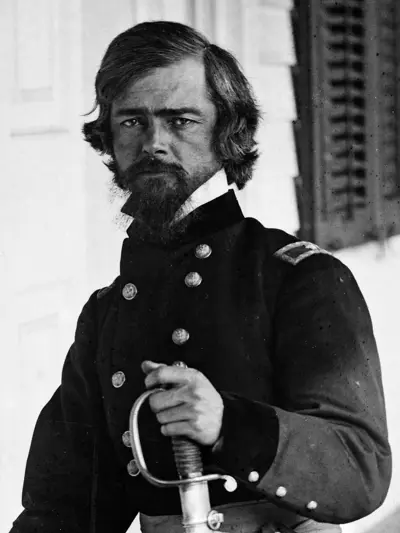
Isaac Ingalls Stevens was an American career Army officer and politician, who served as governor of the Territory of Washington from 1853 to 1857, and later as its delegate to the United States House of Representatives. During the American Civil War, he held several Union commands. He was killed at the Battle of Chantilly, while at the head of his men and carrying the fallen colors of one of his regiments against Confederate positions. According to one account, at the hour of his death Stevens was being considered by President Abraham Lincoln for appointment to command the Army of Virginia. He was posthumously advanced to the rank of Major General. Several schools, towns, counties, and lakes are named in his honor.
