Ted Kennedy Quotes
With his arrogant usurpation of power and refusal to follow well-established wire-tapping laws, I believe this president is not living up to [his] oath. By shunning the oversight of the courts and ignoring the express language of the laws passed by Congress, this president is, in my judgment, defiantly and stubbornly ignoring the Constitution and the laws passed by Congress.
Ted Kennedy, U. S. Senator (Democrat, MA), Castigation of President George W. Bush, Op-Ed, The Boston Globe, 2005
Sourced by: Eigen's Political and Historical Quotations

President George W. Bush had ignored a federal law and tapped the phones of Americans without probable cause and a warrant issued by a court. The President’s defenders argued that the President, as Commander in Chief, has the Constitutional responsibility to lead the military and protect the nation. Intelligence gathering is part of military activity. Therefore the intelligence gathering is a Constitutional duty and the Congress, under the separation of powers doctrine, may not interfere with the President’s Constitutional Duty to conduct intelligence. Under this doctrine, the President need not obey laws that he believes impinge on his management of the war effort and the defense of the nation. Most legal scholars believe that this argument is nonsense, but the George W. Bush administration has stated the doctrine and it was the subject of much litigation.

The issue had first arisen during the Watergate Scandal, where there was concern that if the House held impeachment hearings of President Nixon, he might refuse to provide documents or order others in the Executive Branch not to testify. In this hearing, they were discussing the possible impeachment of President George W. Bush.

This quotation has much more meaning that similar statements of dozens of other people who claimed Bush should be impeached. The reason is that Fine was a strong conservative wanting to impeach a conservative President and he was the person who drafted the articles of impeachment against President William Clinton which passed the House but Clinton was acquitted by the Senate. So Fine was generally seen as a partisan for Republican Conservatives like Bush and a man who acted strongly against Clinton, and yet he observed in this quotation that Bush’s crimes were more serious. See {583797} for a concurring view on impeachment of Bush.

The United States government had for many years deposited all its funds in a single private bank, the Bank of the United States. In 1833, President Andrew Jackson, without any congressional authorization, ordered the federal deposits to be distributed among state banks instead. The Senate was furious and passed the first resolution of censure of a President in United States history:. Carried by a vote of 26 to 20. Four years later a pro-Jackson Senate majority voted to expunge the resolution.

This notion seems to have first been expressed by Edward S. Corwin in 1940


The view that the Supreme Court was the final arbiter of constitutional controversies was not held in early America.


One of the conundrums of our constitutional system is who has the last word as to what the Constitution means. Essentially it is the judicial branch headed by the Supreme Court. But there are those who believe that the current popular majority should have a say in what is or is not constitutional. If so the legislative branch should have the last word. Still others say that the President is the only person elected by ALL the people, so his opinion most reflects the will of the public. And then there are most who argue that the Constitutional system was created just to avoid the power of currently popular majorities, and the courts should decide based on the Constitution itself. So the statement has very little meaning except that Phillips thinks that the courts have too much power. Whoever gets to decide what is or is not Constitutional will be accused of being “over” the Constitution by those who don’t like the decisions. In our system, that is the courts.


The President had authorized the NSA to spy Americans who might have been suspected of being themselves or being in contact with terrorists without obtaining permission of a court including the Foreign Intelligence Surveillance Act (FISA) special court that had been established for these cases. Instead the administration argues that it was inherent in the powers of the Presidency in time of war.


The Congress over the last century has ceded much of its Constitutional power to the President. Congress has much power to check the President, but just as Congress has not been very competent at legislating, oversight, and conducting hearings and investigations, it has not organized itself to use the powers it has very well.
The George W. Bush administration started a secret program to scan phone calls of Americans without a court order or a warrant in the midst of the War on Terror. New York Times uncovered the illegal program and then the President tried to justify it.


Alberto Gonzalez, White House Counsel and later Attorney General who was forced to resign and David S. Addington, Counsel to the Vice President, had come up with a novel view of the powers of the presidency. They argued that since the President is the Commander in Chief, in a war situation or intelligence gathering thereto, has the Constitutional responsibility for that function, he need not obey any laws of Congress as in the conduct of the war Congress would be impinging on the Constitutional separation of powers which itself was prohibited by the Constitution. The argument did not find any significant legal support but for a while the George W. Bush White House behaved as if this were the law, despite the fact that even in the American Revolution and the War of 1812 Congress passed laws regulating the conduct of the armed forces as is provided for in other parts of the Constitution. Yet even Goldsmith would allow the President some powers that many think are unconstitutional and/or belong to Congress. See {32436}.


President Andrew Johnson had been impeached by the House of Representatives and was being tried in by the Senate. A majority of the Senators voted for conviction but the vote was 1 short of the two-thirds that were needed. Johnson remained in office. These were two of the charges against Johnson. A Century later Presidents commonly did both of these. George W. Bush made reappointment of Senate rejected nominees into an art form but after the Johnson trial, these were never to be considered reasons for impeachment again.


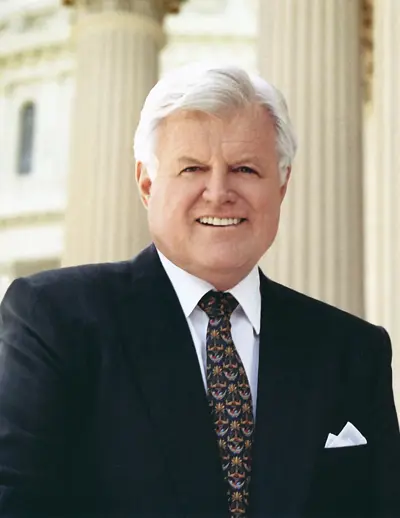
Edward Moore Kennedy was an American politician and lawyer who served as a U.S. Senator from Massachusetts for almost 47 years, from 1962 until his death in 2009. A member of the Democratic Party and the Kennedy political family, he was the second most senior member of the Senate when he died and is the fourth-longest-continuously-serving senator in United States history. Kennedy was the younger brother of President John F. Kennedy and U.S. Attorney General and U.S. Senator Robert F. Kennedy, and was the father of Congressman Patrick J. Kennedy.
