Abigail Adams Quotes
… who are weekly sacrificed upon the gallows in sufficient numbers to astonish a civilized people
It would have been a great shock to her that 200 years later America was among the world leaders in capital punishment and England would have abolished it.
Abigail Adams, 1744-1818, Writer and First Lady (John Adams), Observation on the very large number of criminals who were executed in London, 1784
Sourced by: Eigen's Political and Historical Quotations


Although this is generally followed as a legal principle in America, states like Texas have executed felons who most other jurisdictions would see as Coke’s “mad man.”


In 1938 when Hitler started his military operatiomn to overrun Europe, he abolished beheading with the axe a traditional and barbarous form of capital punishment. The two legal methods of execution in Germany after this decree were hanging and a version of the guillotine.


In his early career, her supported capital punishment, but changed his mind as can be seen in this quotation.


Recalling what the Oklahoma state medical examiner told him about electrocutions.

The most common example that capital punishment does not work as a deterrent is that while thieves were being hung for their crime, other thieves would circulate among the watching crowd at the scaffold and pickpocket the observers.

So many politicians and leaders, cheered by the multitude, actually believe the adulation is for them uniquely.

Several years before the Battle of Bunker Hill, revolutionary activity had already broken out in the American colonies—See {634132} for an example. Parliament passed the Administration of Justice Act of 1774 which gave the British authorities much more “clout” in dealing with the “seditious” American activities. It protected English law enforcement officials from being tried in local Colonial courts for murder or assault or unnecessary force in putting down insurrections in the colonies. Washington and other patriots used this term to describe the Act. Their reason was that under the new law, a British Soldier could kill a colonist and would not be subject to arrest and trial in local colonial courts. So there was no check on the law enforcement authorities use of unnecessary or arbitrary force. English troops could commit murder and never be accountable to the people—hence the name. Ironically, in America today, most of the Federal and state laws on the subject tend to give law enforcement officials the same kind of immunity and impunity which the Founding Fathers found so objectionable. Civilian review boards of police use of force are no allowed in many American communities.

This is one of the sharpest dissents in Supreme Court history. Rarely to justices write opinions accusing other justices of a gross immorality or crime. The majority held that the Supreme Court should not grant a new trial simply because there was some evidence discovered showing him innocent. See {635412} for a quotation from the majority opinion.

The reference to “hanging the Irish” referred to the attempted French invasion of Ireland with Irish Roman Catholic complicity. The English went on a campaign of terror {639231} and there were many hangings such as {639272}.

John Holloway and Benjamin Haggerty went to the scaffold on 22 February 1807 still protesting their innocence over the murder of John Cole Steele on Hounslow Heath five years earlier. They were joined by Elizabeth Godfrey who had been convicted of the wilful murder of Richard Prince the previous Christmas, by stabbing him in the eye with a pocketknife. They were hanged together. According to the Newgate Calendar, a monthly journal of the executions at Newgate Prison in London. It was first published in the middle of the 18th century and later became a monthly magazine of the most salacious crimes in England. This quotation illustrates the great popularity that public execution had become in England. The drew more spectators than athletic events, theaters, or concerts. On this occasion in 1807 there were thosands of deaths and casualties from the unrully and unsupervised mob of spectators.
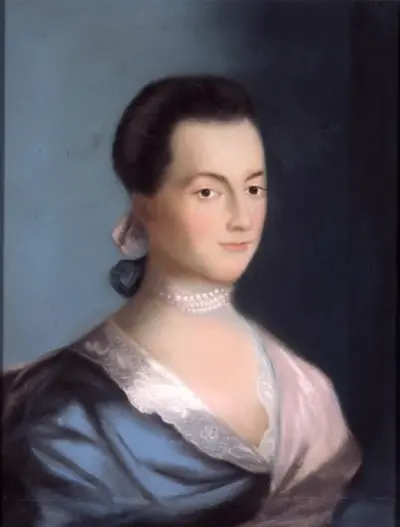
Abigail Adams was the wife and closest advisor of John Adams, as well as the mother of John Quincy Adams. She is sometimes considered to have been a Founder of the United States, and is now designated as the first Second Lady and second First Lady of the United States, although these titles were not used at the time. She and Barbara Bush are the only two women to be married to one U.S. president and the mother of another.
