The Newgate Calendar Quotes
The crowd which assembled to witness this execution was unparalleled, being, according to the best calculation, nearly forty thousand; and the fatal catastrophe which happened in consequence will for long cause the day to be remembered. By eight o’clock not an inch of ground was unoccupied in view of the platform. The pressure of the crowd was such that, before the malefactors appeared, numbers of persons were crying out in vain to escape from it; the attempt only tended to increase the confusion. Several females of low stature who had been so imprudent as to venture among the mob were in a dismal situation; their cries were dreadful. Some who could be no longer supported by the men were suffered to fall and were trampled to death. This also was the case with several men and boys. In all parts there were continued cries ... particularly from the females and children among the spectators, some of whom were seen expiring without the possibility of obtaining the least assistance, everyone being employed in endeavours to preserve his own life.
John Holloway and Benjamin Haggerty went to the scaffold on 22 February 1807 still protesting their innocence over the murder of John Cole Steele on Hounslow Heath five years earlier. They were joined by Elizabeth Godfrey who had been convicted of the wilful murder of Richard Prince the previous Christmas, by stabbing him in the eye with a pocketknife. They were hanged together. According to the Newgate Calendar, a monthly journal of the executions at Newgate Prison in London. It was first published in the middle of the 18th century and later became a monthly magazine of the most salacious crimes in England. This quotation illustrates the great popularity that public execution had become in England. The drew more spectators than athletic events, theaters, or concerts. On this occasion in 1807 there were thosands of deaths and casualties from the unrully and unsupervised mob of spectators.
The Newgate Calendar, March 1807
Sourced by: Eigen's Political and Historical Quotations


Although we think is grizzley and macabre that throngs of people should attend executions adn percieve the spectators to be gross and insensitive, there was a bizarre kind of morality operating in many counties. At all times in history executions tend to bet botched with terrible and unnecessary suffering inflicted on the victim. When executioners do that with drug coctails or other methods of dispatching death, we tend to make institutional complaints. But as this quotation shows, the executioner was often turned on by the mob and in some cases were actually themselves killed.

There was, and still is in some parts of the world, this belief taht one of the main reasons for capital punioshment with visible and public executions was to deter others from comitting crimes by seeing the example of what happens to the transgressors. For these people, exemplified by this quotation of Dr. Johnson's, public executions are crime prevention. This notion tirned out to have been a fallacy. In England they found that during every public hanging, skilled pickpockets would steal from the onlookers who were tranfixed on the macabre secene--this despite the fact that pickpocketing was a hanging offence.
Public Hangings in America were not abolished for another six decades. See Quotation 644484 in Related Quotes.
The United States was very backward in terms of abolishing public hangings, In Great Britain, they had abolioshed piblic hanging six decades earlier and viewed America as somewhat backward and barbarian in this respect.. See Related Quotation 644488.

Charles Dickens himself, a true nineteenth-century liberal, lent his weight to the campaign to abolish public executions. After seeing the execution of Maria and Frederick Mannings for murdering Maria’s lover, Patrick O’Connor, in Horsemonger Lane, outside the Surrey County Gaol on 13 November 1849, he wrote this to the Times. Public hangings were abolished in 1868. The last one took place outside Newgate Prison on 26 May of that same year. The man hanged was an Irish terrorist called Michael Barratt who had blown up the Clerkenwell House of Detention killing six people. A drunken crowd stayed up all night to witness the execution. They cheered wildly when the scaffold was brought out at dawn. More people – mainly young women and children – began to arrive. By the time a bell was sounded at eight o’clock in the morning to announce the arrival of the condemned man, the crowd stretched back as far as Smithfield.


It would have been a great shock to her that 200 years later America was among the world leaders in capital punishment and England would have abolished it.
These types of macabre superstitious beliefs about the powers of the immediately dead, have arisen on many cultures and societies


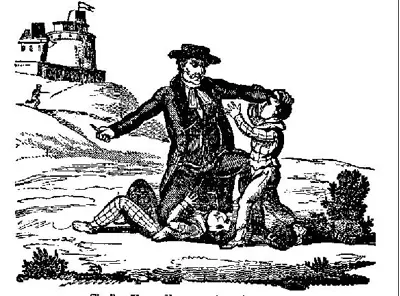
The Newgate Calendar, subtitled The Malefactors' Bloody Register, was a popular work of improving literature in the 18th and 19th centuries.
