Charles Dickens Quotes
I believe that a sight so inconceivably awful as the wickedness and levity of the immense crowd collected at that execution this morning could be imagined by no man, and could be presented in no heathen land under the sun. The horrors of the gibbet and of the crime which brought these wretched murderers to it faded in my mind before the atrocious bearing, looks, and language of the assembled spectators. I came upon the scene at midnight…As the night went on, screeching and laughing, and yelling in strong chorus of parodies on Negro melodies, with substitutions of “Mrs Manning” for “Susannah” and the like were added to these. When the day dawned, thieves, low prostitutes, ruffians, and vagabonds of every kind, flocked on the ground, with every variety of offensive and foul behaviour…When the sun rose brightly, it gilded thousands upon thousands of upturned faces, so inexpressibly odious in their brutal mirth or callousness that a man had cause to feel ashamed of the shape he wore. When these two miserable creatures, who attracted all this ghastly sight about them, were turned quivering into the air there was no more emotion, no more pity, no more thought that two immortal souls had gone to judgement, than if the name of Christ had never been heard in this world
Charles Dickens himself, a true nineteenth-century liberal, lent his weight to the campaign to abolish public executions. After seeing the execution of Maria and Frederick Mannings for murdering Maria’s lover, Patrick O’Connor, in Horsemonger Lane, outside the Surrey County Gaol on 13 November 1849, he wrote this to the Times. Public hangings were abolished in 1868. The last one took place outside Newgate Prison on 26 May of that same year. The man hanged was an Irish terrorist called Michael Barratt who had blown up the Clerkenwell House of Detention killing six people. A drunken crowd stayed up all night to witness the execution. They cheered wildly when the scaffold was brought out at dawn. More people – mainly young women and children – began to arrive. By the time a bell was sounded at eight o’clock in the morning to announce the arrival of the condemned man, the crowd stretched back as far as Smithfield.
Charles Dickens, Letter to The London Times, November 12, 1849
Sourced by: Eigen's Political and Historical Quotations

Queen Boudicca of the Iceni tribe had revolted in Roman Britain. The Romans where particularly harsh in putting down revolts but under Emperor Nero and Caligula after him, they sunk to the deepest of barbarities,


Although we think is grizzley and macabre that throngs of people should attend executions adn percieve the spectators to be gross and insensitive, there was a bizarre kind of morality operating in many counties. At all times in history executions tend to bet botched with terrible and unnecessary suffering inflicted on the victim. When executioners do that with drug coctails or other methods of dispatching death, we tend to make institutional complaints. But as this quotation shows, the executioner was often turned on by the mob and in some cases were actually themselves killed.

This has been the case in EVERY jurisdiction that has had capital punishment. Capital punishment does provide vengeance for victims, relatives and society. And in many societies execution is less expensive than prison for life. But it has never curtailed crime despite the example. In London, they used to have public executions as examples to inhibit crime. While the crowd was watching a pickpocket be hung, other pickpockets were relieving many spectators of their wallets and watches.

There was, and still is in some parts of the world, this belief taht one of the main reasons for capital punioshment with visible and public executions was to deter others from comitting crimes by seeing the example of what happens to the transgressors. For these people, exemplified by this quotation of Dr. Johnson's, public executions are crime prevention. This notion tirned out to have been a fallacy. In England they found that during every public hanging, skilled pickpockets would steal from the onlookers who were tranfixed on the macabre secene--this despite the fact that pickpocketing was a hanging offence.


Yuliy Osipovich Martov. Criticism of the Bolshevik behavior in dealing with counter-revolutionaries in the civil war that followed the Russian Revolution. This despite the fact that the death penalty had been abolished right after the Revolution. See {590510}


1st Baron Macaulay

These murders were punished by burning at the stake and other gruesome forms of execution as if a king had been murdered.


The English loved the operettas making fun of themselves. Some of the phrases such as this one ended up being used in serious political debate. See {616511}.


“Catiff” is a Middle English term to describe a lowly, despicable person.


The king was found guilty and was decapitated, but not wearing a crown.
The victim would be slowly cut 1000 times in ways to inflict more and more pain but not kill the victim rapidly.
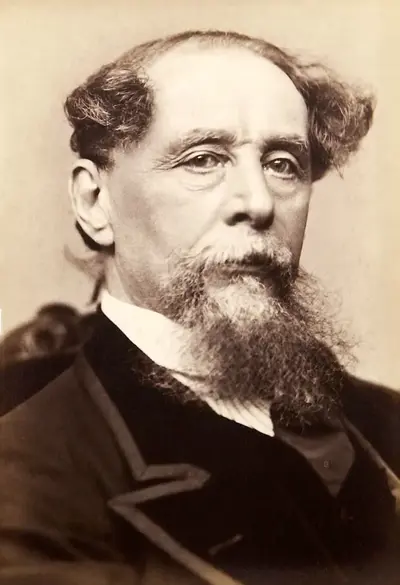
Charles John Huffam Dickens FRSA was an English writer and social critic. He created some of the world's best-known fictional characters and is regarded by many as the greatest novelist of the Victorian era. His works enjoyed unprecedented popularity during his lifetime and, by the 20th century, critics and scholars had recognised him as a literary genius. His novels and short stories are widely read today.
