Voltaire Quotes
It is forbidden to kill; therefore all murderers are punished unless they kill in large numbers and to the sound of trumpets.
"Rights" (1771), Questions sur l'Encyclopédie (1770–1774)
Sourced by: Eigen's Political and Historical Quotations

A number of the American soldiers refused to obey Calley's illegal order. Some helped some villagers to escape, and a helicopter pilot landed betreen Callery's men and the villagers they were shooting at, and ordered his helicopter machine gun crew to fire on the soldiers if they did back off. The soldiers stopped firing at the civillians. However, his and other reports of the massacre were covered up by the military for a few years. Mai Lai was not the only major war crime perpetrated by Americans in the Vietnam War; there had been a few others. But given the years of fighting and the many opportunities war crimes violations under orders were quite rare. The Viet Cong had many more war crimes that they perpetrated, and our South Vietnamese allies repeatedly committed war crimes against their own people.


It was common then for people to die in tenements as a result of shoddy construction, poisoning by sewer gas, and unsanitary conditions. As the result of the efforts of reformers like Riis and Theodore Roosevelt health inspectors were appointed and errant builders went to jail—in some cases for manslaughter.

Description of one of his experiences in the Spanish American War.


The implication of this sura is that it is permissible to kill non-Muslims but not Muslims. The same is true of slavery. Another prescription of this sura is that a Muslim should never kill another Muslim, so while this sura is very discriminatory and in that sense reprehensible, it does call into question the Islamic terrorist practice of the late 20th and early 21st century of killing fellow Muslims who might vote, serve in an official role or cooperate with non-believers. And it definitely to the Western mind prohibits the kind of Islamic sectarian violent practice of Sunni Muslims and Shiite Muslims torturing and butchering each other—a practice that has continued since the two groups fought over who was the rightful successor to Muhammad. The religious rationale for that murderous behavior is that each Islamic group sees the other as apostate and therefore no longer real Muslims.


This proverb only makes sense in the light of understanding the Arab concept of revenge—“blood.” In a rural desert environment where little can be expected of government, the Arabs have developed a law enforcement and peace keeping mechanism which while primitive from modern standards, nevertheless worked to some degree. It is that revenge—“blood” is a moral necessity and obligation of all people, and revenge is not limited by time or to the individuals involved in the first incidence. The immediate family are the first to extract revenge, but the extended family follows and often the entire clan. Sometimes revenge is tribal or even national. Anyone who fails to revenge a member in his group is not only a disgrace, but is a clear and present danger to the group because then they can be attacked with impunity. So revenge is a strong obligation of the group members and blood must be paid with blood no matter how many generations it may take. The only thing that keeps me and my family safe, is the surety what whosoever kills one of us will themselves be killed or if they die a natural death we will take revenge on one of the evildoers relatives. Crime must never pay!


This was a precursor of the total war views of William Tecumseh Sherman and Ulysses S. Grant during the American Civil War half a century later.


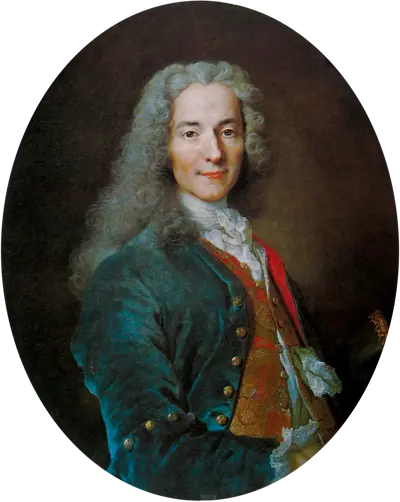
François-Marie Arouet, known by his nom de plume Voltaire (/vɒlˈtɛər, voʊl-/; also US: /vɔːl-/; French: [vɔltɛːʁ]), was a French Enlightenment writer, historian, and philosopher famous for his wit, his criticism of Christianity—especially the Roman Catholic Church—as well as his advocacy of freedom of speech, freedom of religion, and separation of church and state.
