John Stuart Mill Quotes
Murder of a man by his wife was called treason (petty as distinguished from high treason), and was more cruelly avenged than was usually the case with high treason;
These murders were punished by burning at the stake and other gruesome forms of execution as if a king had been murdered.
John Stuart Mill, 1806-1873, Member of Parliament, British Political Economist, The Subjugation of Women, 1869
Sourced by: Eigen's Political and Historical Quotations

Her view was only held by a few British citizens. Capital Punishment was ended in Britain.


1st Baron Macaulay

Some modern versions of the Koran annotate the “beating” injunction and argue that this should only be used as a last resort. This is an example of socially unacceptable anachronisms that are found in the scripture of most older religions. All but the radical fundamentalists do not take these passages literally.


There is not much difference between England then and America now.

Nathaniel Bacon had led a rebellion in Virginia and had routed the Governor’s troops and caused him to flee leaving control of Virginia to Bacon and his followers who were far more democratic and advanced. However Bacon succumbed to swamp fever, and his followers could not hold the colony together giving the Governor a chance to establish his authority. He then went on a vengeful reign of terror, executing all of Bacon’s followers he could get his hands on. With no danger to the authority of the Crown, King Charles felt that Berkeley had gone too far. The King’s father Charles I had been executed in the aftermath of the English Civil War, but he had executed far fewer than Berkely had done in Virginia.


The victim would be slowly cut 1000 times in ways to inflict more and more pain but not kill the victim rapidly.

Charles Dickens himself, a true nineteenth-century liberal, lent his weight to the campaign to abolish public executions. After seeing the execution of Maria and Frederick Mannings for murdering Maria’s lover, Patrick O’Connor, in Horsemonger Lane, outside the Surrey County Gaol on 13 November 1849, he wrote this to the Times. Public hangings were abolished in 1868. The last one took place outside Newgate Prison on 26 May of that same year. The man hanged was an Irish terrorist called Michael Barratt who had blown up the Clerkenwell House of Detention killing six people. A drunken crowd stayed up all night to witness the execution. They cheered wildly when the scaffold was brought out at dawn. More people – mainly young women and children – began to arrive. By the time a bell was sounded at eight o’clock in the morning to announce the arrival of the condemned man, the crowd stretched back as far as Smithfield.
Note that the fact that she had suffered sposal abuse. She poisoned her husband who repeadedly beat her and her children. Althoughh the evidence was heard, there was nothing that could in the then German legal system used to justify the killing of a husband. Germany was not then the only country which would not allow violent spousal abuse as a defense or a mitigating factor in the sentence. The German punishment for a woman murdering her husband was then beheading. Even as late as the mid 19th century, they were still decapitating trangressors of their laws. The Germans actually developed a special kind of sword with no point just for beheadings.


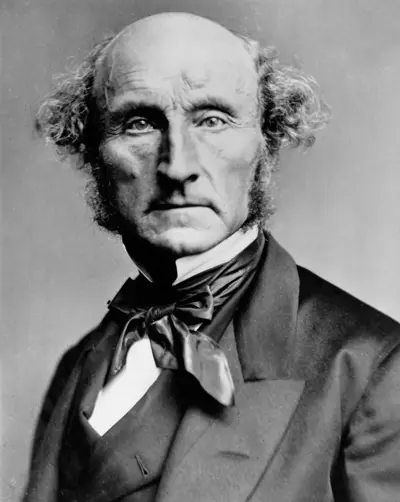
John Stuart Mill, usually cited as J. S. Mill, was an English philosopher, political economist, Member of Parliament, and civil servant. One of the most influential thinkers in the history of classical liberalism, he contributed widely to social theory, political theory, and political economy. Dubbed "the most influential English-speaking philosopher of the nineteenth century", he conceived of liberty as justifying the freedom of the individual in opposition to unlimited state and social control.
