Samuel Johnson Quotes
‘Sir, executions are intended to draw spectators,’ said Dr Johnson. ‘If they do not draw spectators, they don’t answer their purpose.’
There was, and still is in some parts of the world, this belief taht one of the main reasons for capital punioshment with visible and public executions was to deter others from comitting crimes by seeing the example of what happens to the transgressors. For these people, exemplified by this quotation of Dr. Johnson's, public executions are crime prevention. This notion tirned out to have been a fallacy. In England they found that during every public hanging, skilled pickpockets would steal from the onlookers who were tranfixed on the macabre secene--this despite the fact that pickpocketing was a hanging offence.
Samuel Johnson (1709–1784), Quoted in Nigel Cawthorne, Public Executions, Arcturus Publishing, September 28, 2006
Sourced by: Eigen's Political and Historical Quotations

Wade was urging the Prince to abolish the Death by 1000 Cuts {641825} and simply rely on beheading the form of execution for “lesser” crimes. Note that the Prince’s fears and arguments parallel the same given by modern proponents of the Death Penalty—without it criminals would not be controlled and instability would ensue.

Although this is generally followed as a legal principle in America, states like Texas have executed felons who most other jurisdictions would see as Coke’s “mad man.”


This document was the first organized argument against capital punishment.

1st Marquees of Halifax. Even in the 18th century, it was realized that capital punishment was not a particularly good deterrent. Savile and others observed that there was a significant vengeance motive for state execution.


Sherman was distressed at the full due process and trials that had to be given to Confederate spies and guerrillas and wanted to execute them quickly as an example. He complained to the Judge Advocate General that his men were “losing prisoners in the swamp” which both of them realized meant the immediate execution of prisoners by soldiers and junior officers which Sherman did not like either. The Lincoln administration insisted on the full due process. Even after conviction, President Abraham Lincoln tended to pardon many of the condemned.


He was one of the longest serving District Attorneys in America, He also served the largest jurisdiction of a District Attorney. When he first was elected DA of Manhattan there were over 600 murders a year. When he retired, there were only about 60, a 90% reduction. Yet, his experience was that capital punishment was useless in deterring murder. He had many other techniques far more effective.

In his early career, her supported capital punishment, but changed his mind as can be seen in this quotation.


Charles Dickens himself, a true nineteenth-century liberal, lent his weight to the campaign to abolish public executions. After seeing the execution of Maria and Frederick Mannings for murdering Maria’s lover, Patrick O’Connor, in Horsemonger Lane, outside the Surrey County Gaol on 13 November 1849, he wrote this to the Times. Public hangings were abolished in 1868. The last one took place outside Newgate Prison on 26 May of that same year. The man hanged was an Irish terrorist called Michael Barratt who had blown up the Clerkenwell House of Detention killing six people. A drunken crowd stayed up all night to witness the execution. They cheered wildly when the scaffold was brought out at dawn. More people – mainly young women and children – began to arrive. By the time a bell was sounded at eight o’clock in the morning to announce the arrival of the condemned man, the crowd stretched back as far as Smithfield.


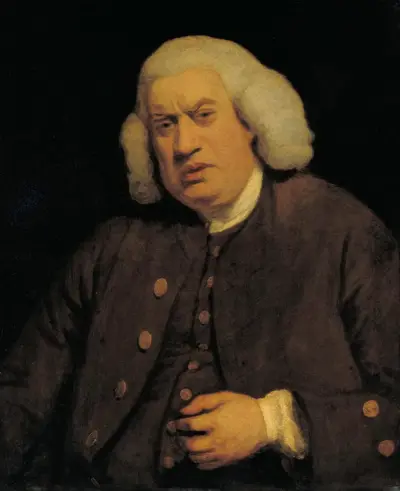
Samuel Johnson, often referred to as Dr Johnson, was an English writer who made lasting contributions to English literature as a poet, playwright, essayist, moralist, literary critic, biographer, editor, and lexicographer. Religiously, he was a devout Anglican, and politically a committed Tory. The Oxford Dictionary of National Biography describes Johnson as "arguably the most distinguished man of letters in English history". He is the subject of James Boswell's The Life of Samuel Johnson, described by Walter Jackson Bate as "the most famous single work of biographical art in the whole of literature".
