Bamberg, Germany Quotes
The poor sinner was weak and ill, so she had to be led to the scaffold. When she sat down on the chair, Master Valtin the executioner walked around her like a cat walks around hot broth. He held the sword a span from her neck, took aim, and struck the blow, but missed her neck and struck off a slice of her head as big as a coin, knocking her from the chair. Then the poor soul got up quicker than she had sat down, this blow having done no harm to her. Then she started to beg to be let go, as she had been so brave. But to no avail. She had to sit down again. The assistant then wanted to take the sword from Master Valtin and strike her himself, but the master would not permit this and struck her again himself. The second blow was a little stronger and she fell from the chair. Then he cut off her head as she lay on the scaffold. The executioner received his reward as he went. He would have been stoned to death if the town guard and their arms had not rescued him. As it was, much blood was already streaming from his head.
Although we think is grizzley and macabre that throngs of people should attend executions adn percieve the spectators to be gross and insensitive, there was a bizarre kind of morality operating in many counties. At all times in history executions tend to bet botched with terrible and unnecessary suffering inflicted on the victim. When executioners do that with drug coctails or other methods of dispatching death, we tend to make institutional complaints. But as this quotation shows, the executioner was often turned on by the mob and in some cases were actually themselves killed.
Bamberg, Germany, Town Records of a Botched Execution, 1641
Sourced by: Eigen's Political and Historical Quotations

Queen Boudicca of the Iceni tribe had revolted in Roman Britain. The Romans where particularly harsh in putting down revolts but under Emperor Nero and Caligula after him, they sunk to the deepest of barbarities,
Schmidt was the Executioner at Nuremberg. Some regard it strange that a n executioner should be concerned witth the suffering of the condemned, but he saw himself as a professional whose job it was to dispatch the guilty, but he saw no reason why that should suffer any more than was necesary.


Charles Dickens himself, a true nineteenth-century liberal, lent his weight to the campaign to abolish public executions. After seeing the execution of Maria and Frederick Mannings for murdering Maria’s lover, Patrick O’Connor, in Horsemonger Lane, outside the Surrey County Gaol on 13 November 1849, he wrote this to the Times. Public hangings were abolished in 1868. The last one took place outside Newgate Prison on 26 May of that same year. The man hanged was an Irish terrorist called Michael Barratt who had blown up the Clerkenwell House of Detention killing six people. A drunken crowd stayed up all night to witness the execution. They cheered wildly when the scaffold was brought out at dawn. More people – mainly young women and children – began to arrive. By the time a bell was sounded at eight o’clock in the morning to announce the arrival of the condemned man, the crowd stretched back as far as Smithfield.
Note that the fact that she had suffered sposal abuse. She poisoned her husband who repeadedly beat her and her children. Althoughh the evidence was heard, there was nothing that could in the then German legal system used to justify the killing of a husband. Germany was not then the only country which would not allow violent spousal abuse as a defense or a mitigating factor in the sentence. The German punishment for a woman murdering her husband was then beheading. Even as late as the mid 19th century, they were still decapitating trangressors of their laws. The Germans actually developed a special kind of sword with no point just for beheadings.


The victim would be slowly cut 1000 times in ways to inflict more and more pain but not kill the victim rapidly.


He had witnessed thousands of Crucifixions and did not favor the method of execution.
See the related quotes for the "ancient views" to which her referred.

He did not want his executioners to dispatch the victim quickly but make him suffer,
Public Hangings in America were not abolished for another six decades. See Quotation 644484 in Related Quotes.

Joseph-Ignace Guillotin was not thye inventor or the execution machine that bears his name. The actual inventor of the prototype was Antoine Louis. However, Guillotin--a physician by training was very concerned that a very high percentage of beheadings were botched by the executioner and the victim suffered greatly. He became the public and political advocate for the reform of the mode of execution in France to reduce suffering. The device ended up with his name as the noun to describe it. In this quotation, he made his first majhor speech to his fellows of the French Chamber of Deputies in 1791. Prior to the Frech Revolution beheading was the method of execution reserved for the Nobility & Aristocracy. They couod pay the executioner a "fee" to be sure that his sword or ax was sharp and that he/she would not suffer much. Nonetheless, many executions were botched. After the Revolution giving ALL citizens the same royal execution if they were convicted felons. So its adoption was a revolutionay act and philosophically based.


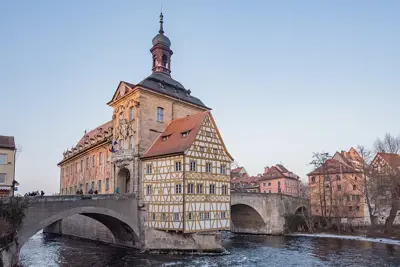
Bamberg (/ˈbæmbɜːrɡ/, US also /ˈbɑːmbɛərk/, German: [ˈbambɛʁk] (listen)) is a town in Upper Franconia, Germany, on the river Regnitz close to its confluence with the river Main. The town dates back to the 9th century, when its name was derived from the nearby Babenberch castle. Cited as one of Germany's most beautiful towns, its old town has been a UNESCO World Heritage Site since 1993, with Bamberg being home to Europe's largest intact old city wall.
