George III Quotes
You ... are to be hanged by the neck, but not until you are dead; for while you are still living your bodies are to be taken down, your bowels torn out and burned before your faces, your heads then cut off, and your bodies divided each into four quarters to be then at the King's disposal; and may the Almighty God have mercy on your souls.
George III, 1738-1820, King of England & Ireland, King of Hanover, Writ approving the death sentence for seven Irish rebels, 1802
Sourced by: Eigen's Political and Historical Quotations


William the Conqueror. This is one of the first if not the first nationwide abolition of capital punishment in history. Ironically, the two alternatives that the abolition law allowed would both be illegal and repugnant to us today even though we allow capital punishment.

Although we think is grizzley and macabre that throngs of people should attend executions adn percieve the spectators to be gross and insensitive, there was a bizarre kind of morality operating in many counties. At all times in history executions tend to bet botched with terrible and unnecessary suffering inflicted on the victim. When executioners do that with drug coctails or other methods of dispatching death, we tend to make institutional complaints. But as this quotation shows, the executioner was often turned on by the mob and in some cases were actually themselves killed.

Livermore's argument fell on deaf ears, and the amendment was passed over the objection of a few arch-conservatives.


Louis Eugene Walcott. Malcolm X had criticized Elijah Mohammed for sexual behavior with staff.

The capital punishment debate was raging in Europe. Belgium and parts of Switzerland had just abolished the death penalty.


Queen Boudicca of the Iceni tribe had revolted in Roman Britain. The Romans where particularly harsh in putting down revolts but under Emperor Nero and Caligula after him, they sunk to the deepest of barbarities,
Schmidt was the Executioner at Nuremberg. Some regard it strange that a n executioner should be concerned witth the suffering of the condemned, but he saw himself as a professional whose job it was to dispatch the guilty, but he saw no reason why that should suffer any more than was necesary.

See the related quotes for the "ancient views" to which her referred.

This is one of the several examples of Biblical injuntions to burn transgressors at the stake. See Related Quotes for others. Both New and Old Testamant not only did not condemn this cruelty, but actually proscribed it. This was one of the reasons that it was so difficult for Christian nations to abolish the practice. This also is a very notewothy Biblical quotation becasue the daughter in law was to be burned at the stake, even thiugh she was pregnant. In the Old Tetament, the fetus was not considered a person and preserving the life of the unborn child was not considered important becasue the fetus only became a person when the head of the baby could be seen emerging from the mother's vagina. Then and only then was their a life that commanded respect and protection.
Note that the fact that she had suffered sposal abuse. She poisoned her husband who repeadedly beat her and her children. Althoughh the evidence was heard, there was nothing that could in the then German legal system used to justify the killing of a husband. Germany was not then the only country which would not allow violent spousal abuse as a defense or a mitigating factor in the sentence. The German punishment for a woman murdering her husband was then beheading. Even as late as the mid 19th century, they were still decapitating trangressors of their laws. The Germans actually developed a special kind of sword with no point just for beheadings.

In 1938 when Hitler started his military operatiomn to overrun Europe, he abolished beheading with the axe a traditional and barbarous form of capital punishment. The two legal methods of execution in Germany after this decree were hanging and a version of the guillotine.

Joseph-Ignace Guillotin was not thye inventor or the execution machine that bears his name. The actual inventor of the prototype was Antoine Louis. However, Guillotin--a physician by training was very concerned that a very high percentage of beheadings were botched by the executioner and the victim suffered greatly. He became the public and political advocate for the reform of the mode of execution in France to reduce suffering. The device ended up with his name as the noun to describe it. In this quotation, he made his first majhor speech to his fellows of the French Chamber of Deputies in 1791. Prior to the Frech Revolution beheading was the method of execution reserved for the Nobility & Aristocracy. They couod pay the executioner a "fee" to be sure that his sword or ax was sharp and that he/she would not suffer much. Nonetheless, many executions were botched. After the Revolution giving ALL citizens the same royal execution if they were convicted felons. So its adoption was a revolutionay act and philosophically based.


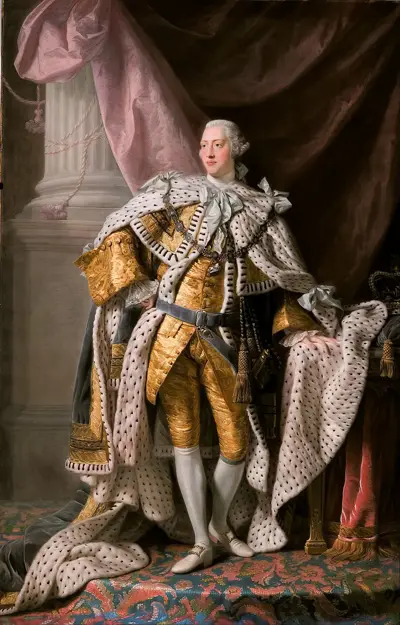
George III was King of Great Britain and Ireland from 25 October 1760 until the union of the two kingdoms on 1 January 1801, after which he was King of the United Kingdom of Great Britain and Ireland until his death in 1820. He was concurrently Duke and Prince-elector of Brunswick-Lüneburg ("Hanover") in the Holy Roman Empire before becoming King of Hanover on 12 October 1814. He was a monarch of the House of Hanover, but unlike his two predecessors, he was born in Great Britain, spoke English as his first language, and never visited Hanover.
