Oldradus de Ponte Quotes
What is done tacitly must be held as if it had been done expressly .
He was the first medieval jurist to write opinions on cases, thus preserving a record for openness and an instrument to teach others and produce uniformity of decisions and judgments—the basis of most legal systems today. This quotation is a principle of most modern legal systems today.
Oldradus de Ponte, ~1275-~1343, Italian Jurist of the Roman Curia, Consilium (Legal Opinion) Number 92
Sourced by: Eigen's Political and Historical Quotations


His refusal to explain the reasons for and the circumstances of the arrests drew much criticism from Democrats and the press. This was the precedent that Presidents have used ever since to not reveal the grounds for arrest and the circumstances thereof. George W. Bush aides specifically cited this when they refused the details of many of the arrests after the 9-11 attack.


This was published just after his death.


Before the Communists, the Nationalist Chinese government controlled the press even more so than the Communists did. And the Chinese Emperors before the Nationalists had a well educated elite of administrators who ran the government but the great mass of the people knew virtually nothing other than what the rulers wanted them to know. With mass illiteracy, there was no efficient way to communicate with the masses anyway. China, with a history of great intellectual accomplishment, has had the most ignorant people in the world by virtue of its size and general illiteracy.

The TPP was the first Trade Agreement that had ever been classified as “Secret” when it was being negotiated. This was one of the most hotly debated policies of the era. Even Congress could not get a look at what was being negotiated although the Senate would have to ratify it when finished for it to become effective. .On the surface, it is outrageous that a non-military or defense activity should be secret in a democracy. What could be wrong with the Congress and the public being aware of a trade negotiation while it was being formulated and negotiated? Kirk and other apologists for the secrecy policy argue that because of the trade-off relationships among different clauses and facets of a trade treaty, there are many proposals that are made just to initiate a bargaining position, and the negotiators themselves neither expect nor intend those proposals to be a part of the final treaty. To then have groups of Americans get upset and start a lobbying position against a treaty when what they object to is not ever going to be in the treaty poisons in the public mind the entire treaty which then could be killed for something that was never real to begin with. A similar thing happened with the Obamacare legislation. Congress drafted the various clauses and many were included as part of the bargaining process or misunderstood because of poor first drafting. Opposition to those clauses set a tone of animosity against the bill as a whole. After the bill was passed, the clauses that were most unpopular or misinterpreted were the main reason that citizens gave for opposing Obamacare even though they were not in the legislation. Advocates of secrecy point out that the original Constitutional Convention was entirely secret with all the delegates agreeing that if each and every proposal that was debated were public, there would develop so much opposition that the result could never be ratified later. Yet it is hard to argue against transparency of government processes in a democracy.


Generally, government agencies and officials see whistleblowers as traitors, not as heroes. They often slander the whistleblower to discredit his/her revelations about the agency’s activities.


He was referring to the massive surveillance NSA program whereby all telephone calls and most digital communications for every American was secretly tapped and stored in an NSA data base. The Senators of the Intelligence Oversight Committee received information in Classified executive sessions but they were not allowed to disclose anything that they learned in the briefings—even something as huge and probably unconstitutional as this program. Moreover, even when officials of the Intelligence Services lied under oath (see {634917}) in open session, the Senators could not disclose this fact.


Trust is undermined in 2 ways. Allies and others who speak or negotiation with the government in confidence, lose trust in the government to maintain the appropriate level of confidentiality and security over information. And second, citizens lost trust in the government because they have been secretive and kept information from the citizenry that usually is just embarrassing or being kept secret to avoid opposition. Worst is when the leak shows that the Government has been lying to the public. Where there are what the public regards as legitimate secrets, public trust is not diminished, but those instances are not typical.


Marcus Porcius Cato

The issue was still not decided by the beginning of the 21st Century except that a certain amount of public disclosure was required if the company raised funds by selling stock to the public, but there were some giant corporations that were private and exercised huge power and influence and yet whose operations were secret.


The Scientific Project that developed the Atomic Bomb. Oppenheimer was the great physicist who directed the successful development of the atomic bomb so as to build the weapon before Hitler did in World War II. However, as the technology evolved, he had doubts as to the wisdom of creating even more powerful hydrogen weapons. His viewpoint was hurting the administration’s policy of rapid unlimited nuclear weapons development, and he was the victim of a character assassination whereby his security clearance was withdrawn. The “father” of the atomic bomb was the first American casualty of atomic weapons development.

He was a veteran reporter who had worked with many different administrations.

At the time there was no Secrecy & Classification System nor any laws enforcing secrecy or confidentiality. However there was no freedom of information laws of expectations even on the part of journalists. This was the first Freedom of Information policy of the American government. Some politicians were more open than others but there was no national, governmental before this. There were however leakers and whistleblowers though the terms were not in use. Note that Roosevelt herein created the first whistle blower protection—himself.


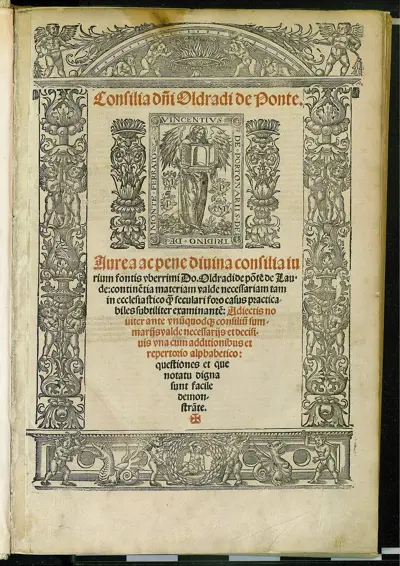
Oldradus de Ponte (died 1335) was an Italian jurist born in Lodi, active in the Roman curia in the early fourteenth century. Previously he had taught at the University of Padua. According to Joseph Canning he was an authority in both canon law and civil law, and his consilia (legal opinions) are the earliest surviving ones.
