Darius I Quotes
What government can possibly be better than that of the very best man in the whole state?
The Monarchy was chosen and Darius was monarch. See {612225}
Darius I [the Great], 549-485 BC, King of Persia, Debate of the Persian Counsel on the form of government to adopt
Sourced by: Eigen's Political and Historical Quotations

Darius argued for a monarchy and became king. . See {611015}
Many of the early democracies had failed when in crises the citizens turned to a strong leader who soon became a monarch. The early democracies did not have the mature democratic institutions that we now know are so important for the success of a democracy.

This was the first contact between the colonists and the French government. The French agent was very non committal and the parties were just feeling each other out. Franklin made it perfectly clear that the colonists would not trade the English King for a French one and become part of the French empire.


The absurdity was that Adolf Hitler had more unilateral power and authority than and king did in the 20th century.


The Prime Minister was coping with a scandal where there was an incident where British soldiers had abused Iraq prisoners of war. They were being held to account criminally.


Commenting on the concept of democracy and it's lack of Biblical justification:


General Prim was commenting on the shift in popular support in Spain from a monarchy to a republic.
This Cahier was the consensus of the Clergy of Blois in 1789. There were cahiers of several provinces of France—some by the clergy, some by the nobles. What is fascinating is the emergence of many of the pre-revolutionary French concepts. The example of the American revolution and its principles was known throughout the educated classes of France.


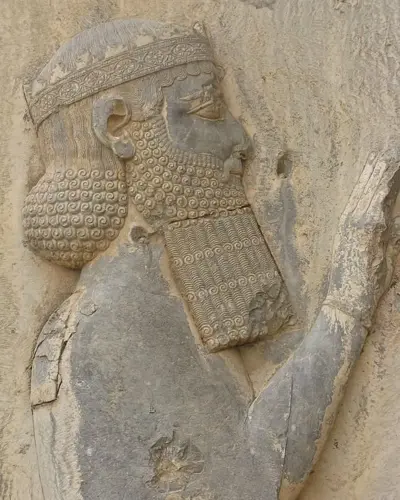
Darius I (c. 550 – 486 BCE), commonly known as Darius the Great, was the third Persian King of Kings of the Achaemenid Empire, reigning from 522 BCE until his death in 486 BCE. He ruled the empire at its peak, when it included much of West Asia, parts of the Caucasus, parts of the Balkans (Thrace-Macedonia, and Paeonia), most of the Black Sea coastal regions, Central Asia, as far as the Indus Valley in the far east and portions of north and northeast Africa including Egypt (Mudrâya), eastern Libya, and coastal Sudan.
