Robert Purvis Quotes
What a burning shame it is that many of the pieces on the subject of slavery and the slave trade, contained in different school books, have been lost sight of, or been subject to the pruning knife of the slaveholding expurgatorial system!
Almost every political controversy that continues for years, ends up battleing for treatment in the school curriculum. Many modern Americans think that the fights over sex education and evolution in schools is a new thing.
Robert Purvis, 1810-1898, Abolitionist, Reformer & Co-Founder of the Underground Railroad, President of the Pennsylvania Anti-Slavery Society, Letter to Willima Garrison, March 5, 1842
Sourced by: Eigen's Political and Historical Quotations


Many of the Americans captured by the Islamic Barbary pirates in the years leading up to the Barbary War were sold into slavery. Eaton, who was the American consul at Tunis, couldn’t help but notice the tragic parallel between the suffering of those captured by the pirates and slaves in the American South.
Downing was the brother-in-law of the Governor. Many people think that the Puritans were very moral people but they were not that so much as rigid. There was no moral compunction for example against slavery as this letter shows.
There are a small body of historians who believe that the Ancient Egyptians were dark skinned Africans and that American and European archeologists and historians, together with their Arab counterparts and Arab workers, have either unwittingly or deliberately ignored or erased the evidence that Ancient Egyptians were Black. The majority of historians and archeologists believe that ancient Egypt was a multi-racial society with extensive intermarriage. The Nubians to the South (Sudan) were and are very dark-skinned, the Lybians in North Africa were much like the Arabs of toady, and there were Greeks and other Caucasians who were in Egypt which was one of the centers of world civilization that attracted people from all over. The Pharoh of Egypt, Ptolemy was a white Greek—one of the Generals of Alexander the Great, and Cleopatra was descended from him and more traditional Egyptians. The Black Egyptian notion seems to have emanated from a statement made by Black leader, Marcus Garvey {618973} .

As a young boy, Moyers lived and went to school in Texas where the state has control over all the schools’ curricula and slavery was taught about with little reality.

The cotton industry and slavery were a very important part of the economy of Providence, RI. The Rhode Island cotton mills were supplied by Southern cotton produced by slaves and carried from the South on Rhode Island ships. Many of the southern slaves were kidnapped from Africa from Rhode Island slave trading ships. When the slave trade was made illegal, Brown was the first slave trader prosecuted. His brother, Moses Brown, a vehement abolitionist was one of the men who brought the prosecution.

After his Presidency, Adams served in the House of Representatives for many years and was thus active in politics.

The Mormons were in Missouri at the time. Phelps was warning the church members essentially not to get involved with the slavery issue. The Mormon Church tended to support the institution of slavery at that time although Mormons themselves did not own slaves. However, we should remember that the Mormons themselves were a very persecuted group and Phelps and other Church leaders probably didn’t want their members alienating the non Mormons more than they already did by their existence. This was very similar to the Roman Catholic Church leaders at the time. The Catholics were also a persecuted minority and the Catholic Bishops often supported slavery—especially in the South to try and avoid hostility from the power structure and the majority. Some individual Mormons and individual Catholics were much opposed to slavery. See {629158} and {629154} for more on the Mormons and slavery. Later, Smith altered his early view.


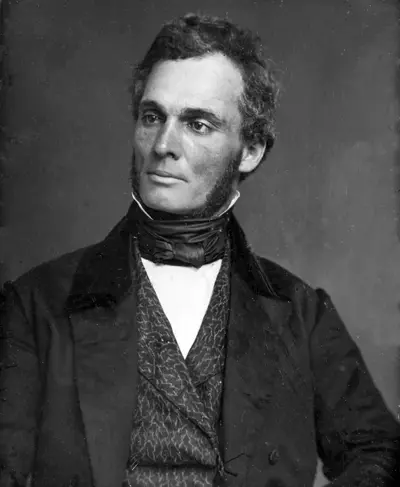
Robert Purvis was an American abolitionist in the United States. He was born in Charleston, South Carolina, and was likely educated at Amherst Academy, a secondary school in Amherst, Massachusetts. He then spent most of his life in Philadelphia, Pennsylvania. In 1833 he helped found the American Anti-Slavery Society and the Library Company of Colored People. From 1845–1850 he served as president of the Pennsylvania Anti-Slavery Society and also traveled to Britain to gain support for the movement.
