Ethel Rosenberg Quotes
Well, it was alleged that he was a member of the Communist Party.
Rosenberg, Ethel. Testimony. Transcript of Record: Supreme Court of the United States October Term, 1951, No. 111, Julius Rosenberg and Ethel Rosenberg, Petitioners, vs. The United States of America, U.S. Government Printing Office, 1952, pp. 1296-1426.


He lists a number of employees including his own wife. The foundation was the L. Ron Hubbard Dianetic Research Foundation Inc. In this case a religious leader was asking the government for assistance in determining who was and was not fit to be a member and an associate of his organization. The FBI apparently ignored his accusations, and there was no government action though he continued to accuse associates throughout his life. The FBI agent who met with Hubbard to investigate his charges wrote “mental case” on the file.

This quotation illustrates one end of the range of union leadership regarding communism. Some union leader were communists; some were pro Marxist but against the Russian style of dictatorial communism. Others did not care for Communism at all but saw the communists as an effective tool that really frightened American corporate management and politicians so they looked reasonable by comparison and they therefore wanted the communists around. Last were those like Reuther who was aggressively anti-communist and wanted labor to expel them whenever they turn up. However, what is ironic is that Reuther himself was labeled a Communist by many right wingers who also used Reuther’s “duck” test. Reuther wanted a national health insurance system; so did the Communists. He advocated and end to segregation; so did the Communists. He fought for workers having a say in management, a classic communist demand, and many other similarities.


So often in America, citizens and government officials have made alliances or joined organizations under the theory that “the enemy of my enemy must be my friend.” It has almost always been a mistake ranging from joining the Communist Party in the 1930s to supporting the dictators or the Middle East, Asia, and South America. In the 1930s Fascism was growing and already on the march and neither America nor England—the leading democracies were not doing anything to combat the threat. America was emerging from the Great Depression, had a string Isolationist movement, and a small but influential group of Fascists and Hitler enthusiasts. Also, no one outside of Russia knew about the Stalin atrocities.

Seeger’s admission was typical of tens of thousands of Americans who had become disillusioned with the fairness, equity, and effectiveness of capitalism during the depression. They were easy prey for Communist propaganda which pointed out all the problems in American society from legal racial discrimination to lack of a social safety net while at the same time lying about the Russian achievements and hiding the horrible abuses of human rights—especially the political murders of millions of people. Then the truth about Russia emerged, Seeger and so many others abandoned the Communist Party as at the same time America was improving its society and beginning to try and deal with the great problem that had plagued America from its inception—racism and slavery.


After this, no other member of the Executive branch went before McCarthy again

This was the typical language of the 1940’s and 1950’s at the height of the Red Scare used by the FBI and others to smear their opponents and political enemies. Seldes had published an article very critical of the FBI and its investigations of labor unions and other liberal organizations. See George Seldes, 1940 quotation.


McCarthy accused thousands of people of being communists and disloyal. He claimed to have lists of communists in universities, the Army and other agencies of government, but never produced such lists. In addition to being a overbearing demagogue, he suffered (and died from) from a serious case of alcoholism. McCarthy’s false and irresponsible attacks eventually caused the Senate to censure him. That and his drinking destroyed his career. Not a single person “exposed” by McCarthy was ever convicted of anything. Many had their careers destroyed however. A number of universities fired Professors because at an earlier phase of their careers, they had been a member of an organization that was communist or affiliated with communists, and then left. These firings led to intensive efforts to strengthen the rules of tenure and academic freedom so that the McCarthy abuses could never be repeated. McCarthy could not be sued for his defamatory lies as he always made his accusations from the floor of the Senate where there is absolute protection even for malicious and irresponsible statements.

Political Parties go through transformations. In the 1950s the Republican Party had a core that was viciously attacking opponents and calling them Communists and traitors. In the early 21st century, their concern for the National Interest again was dwarfed by the desire to win and hold power, only this time intentional gridlock was added to the slanders. The Democrats have gone through unpatriotic ethical lapses as well. Parties are dynamic and change.
The nation was facing the scourge of McCarthyism. Senator Smith was the most courageous member of the Senate in denouncing the lying demagogue of her own party who was so powerful at the time—Joseph R. McCarthy. At the same time, there were some communists trying to undermine the values or the nation as well as the fascists. Smith was one of the first to recognize the danger of both.

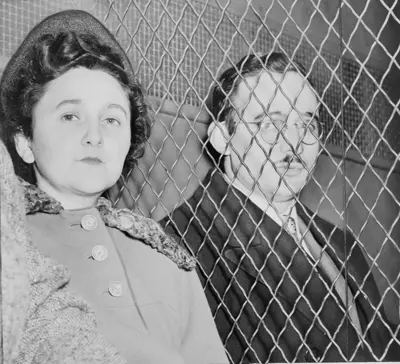
Julius Rosenberg and Ethel Rosenberg (née Greenglass) were American citizens who were convicted of spying on behalf of the Soviet Union. The couple were accused of providing top-secret information about radar, sonar, jet propulsion engines and valuable nuclear weapon designs (at that time the United States was the only country in the world with nuclear weapons). Convicted of espionage in 1951, they were executed by the federal government of the United States in 1953 in the Sing Sing correctional facility in Ossining, New York, becoming the first American civilians to be executed for such charges and the first to suffer that penalty during peacetime.
