Dalton Trumbo Quotes
People joined the Communist Party because it was doing something. It was fighting Fascism.
So often in America, citizens and government officials have made alliances or joined organizations under the theory that “the enemy of my enemy must be my friend.” It has almost always been a mistake ranging from joining the Communist Party in the 1930s to supporting the dictators or the Middle East, Asia, and South America. In the 1930s Fascism was growing and already on the march and neither America nor England—the leading democracies were not doing anything to combat the threat. America was emerging from the Great Depression, had a string Isolationist movement, and a small but influential group of Fascists and Hitler enthusiasts. Also, no one outside of Russia knew about the Stalin atrocities.
Dalton Trumbo, 1905-1976, Film Screenwriter, PBS American Masters: Dalton Trumbo, May 25, 2011
Sourced by: Eigen's Political and Historical Quotations

Trumbo was one of the Liberal victims of McCarthyism, the Red Scare and the Hollywood Blacklist because he refused to testify before the Congressional Committees regarding other people’s political beliefs and affiliations. He has long espoused Liberal causes and was extremely influential writing two Academy Award winning screenplays which were awarded to other screenwriters who were fronting for him as he was Blacklisted as a member of the original “Hollywood 10”. Today, convictions of that type would not stand Constitutional muster, but in those days it did. Trumbo had been a Communist for a while as he explained in {623794}.


First Mormon Cabinet Member

He had asked a family friend not to bring books by Hemmingway into his home. The friend asked why and received this answer. Koch and his brother were the largest political contributors in the United States, so they had enormous influence on Republicans (they only made political contributions to conservative organizations).


This was the typical language of the 1940’s and 1950’s at the height of the Red Scare used by the FBI and others to smear their opponents and political enemies. Seldes had published an article very critical of the FBI and its investigations of labor unions and other liberal organizations. See George Seldes, 1940 quotation.


Eastland was one of the most paranoid politicians of the late 20th century or so cynical that he made these charges to pander to the extreme racists in Mississippi. He claimed that Martin Luther King’s civil rights movement was full of communists to which King replied, “There are as many communists in this movement as there are Eskimos in Florida.”


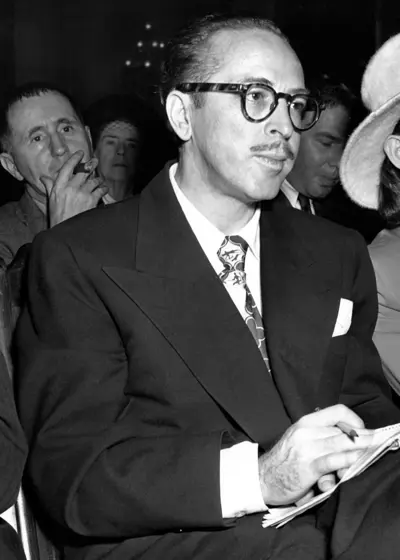
- Born: December 9, 1905
- Died: September 10, 1976
- Nationality: American
- Profession: Screenwriter
James Dalton Trumbo was an American screenwriter and novelist who scripted many award-winning films, including Roman Holiday (1953), Exodus, Spartacus (both 1960), and Thirty Seconds Over Tokyo (1944). One of the Hollywood Ten, he refused to testify before the House Un-American Activities Committee (HUAC) in 1947 during the committee's investigation of Communist influences in the motion picture industry.
