Edward Dmytryk Quotes
With me it was that defending the Communist Party was something worse than naming the names.
Severo, Richard. "Edward Dmytryk, Film Director, Dies at 90." The New York Times, 3 July 1999, p. A11.


He lists a number of employees including his own wife. The foundation was the L. Ron Hubbard Dianetic Research Foundation Inc. In this case a religious leader was asking the government for assistance in determining who was and was not fit to be a member and an associate of his organization. The FBI apparently ignored his accusations, and there was no government action though he continued to accuse associates throughout his life. The FBI agent who met with Hubbard to investigate his charges wrote “mental case” on the file.

Seeger’s admission was typical of tens of thousands of Americans who had become disillusioned with the fairness, equity, and effectiveness of capitalism during the depression. They were easy prey for Communist propaganda which pointed out all the problems in American society from legal racial discrimination to lack of a social safety net while at the same time lying about the Russian achievements and hiding the horrible abuses of human rights—especially the political murders of millions of people. Then the truth about Russia emerged, Seeger and so many others abandoned the Communist Party as at the same time America was improving its society and beginning to try and deal with the great problem that had plagued America from its inception—racism and slavery.

This quotation illustrates one end of the range of union leadership regarding communism. Some union leader were communists; some were pro Marxist but against the Russian style of dictatorial communism. Others did not care for Communism at all but saw the communists as an effective tool that really frightened American corporate management and politicians so they looked reasonable by comparison and they therefore wanted the communists around. Last were those like Reuther who was aggressively anti-communist and wanted labor to expel them whenever they turn up. However, what is ironic is that Reuther himself was labeled a Communist by many right wingers who also used Reuther’s “duck” test. Reuther wanted a national health insurance system; so did the Communists. He advocated and end to segregation; so did the Communists. He fought for workers having a say in management, a classic communist demand, and many other similarities.


The Copperheads were the Northern pro-South and anti-war faction of the Civil War.

After this, no other member of the Executive branch went before McCarthy again

He like many others had signed petitions for good causes that were circulated by Communist organizations. Racists then used that fact to claim that desegregation, voting rights and anti-lynching laws were communist ideas. With the Red Scare operating in the 1950s, Terkel, like so many others were Blacklisted and denied opportunities to earn a living. Many claimed that they had been duped and don’t really believe in these causes. Some like Terkel would not. He opposed most of the Communist programs, but agreed with some. Ironically, ideas like anti-lynching and voting rights which were then labeled as Communist ideology, are today supported by the vast majority of Americans.


See the Related Quotation for a good contemporary example of the clerics whop were party tools.

In contrast to Trump, most political leaders engender loyality via their exemplary and admirable personal qualities and character and/or via a shared philosophy or ideology. Their loyalty tends to transcend proagmatics and the utility of the moment.


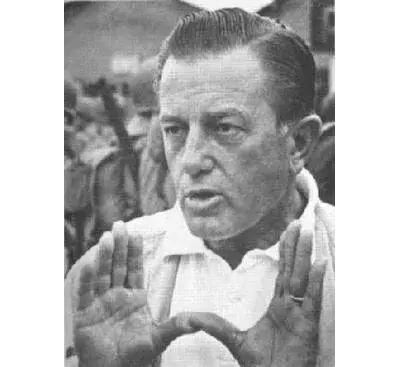
Edward Dmytryk was a Canadian-born American film director. He was known for his 1940s noir films and received an Oscar nomination for Best Director for Crossfire (1947). In 1947, he was named as one of the Hollywood Ten, a group of blacklisted film industry professionals who refused to testify to the House Un-American Activities Committee (HUAC) in their investigations during the McCarthy-era 'Red scare'. They all served time in prison for contempt of Congress. In 1951, however, Dmytryk did testify to HUAC and rehabilitated his career. First hired again by independent producer Stanley Kramer in 1952, Dmytryk is likely best known for directing The Caine Mutiny (1954), a critical and commercial success. The second-highest-grossing film of the year, it was nominated for Best Picture and several other awards at the 1955 Oscars. Dmytryk was nominated for a Directors Guild Award for Outstanding Directorial Achievement in Motion Pictures.
