Nathaniel Ward Quotes
We [Puritans] have been reputed a Colony of wild Opinionists, swarmed into a remote wilderness to find elbow-room for our fanatic Doctrines and practices.
Nathaniel Ward, ~1578-1652, Puritan Leader & Codifier, Against Toleration, 1647
Sourced by: Eigen's Political and Historical Quotations

Both Puritans and Quakers were persecuted and physically abused in England by the Anglican Church. The Puritans as soon as they became dominant in part of the American colonies began persecuting Quakers. The Quakers who were the majority in the Pennsylvania colony, however were tolerant of other religions. This history was another of the many reasons the Founding Fathers wanted no established church. A “scorpion” was a type of whip that was particularly painful.

Ingersoll was considered to be the greatest orator and political thinker of his day, but his overt atheistic views curtailed his elected political career.


Anne Hutchinson was tried by the Puritan religious and civil court for heresy. She started with Bible Study classes in her home and drew a substantial following. The clergy at the time were threatened and outraged. It was one thing for a woman to teach Bible Study to other women, but to also have men with the women was too much. The decision of the court was that she was banished from the colony. See {584753}.

This was the beginning of the inquisition.

While not in the Koran, this attributed statement is the basis for the ban on non-Muslims going on a Hajj and going to the most holy Muslim places—Mecca, Mina, Muzdalifa, and Arafat as well as the anti-religious hostility to all religions but Islam which is present in some Muslim countries.


Official List of groups which were prohibited from religiously criticizing the Catholic Church—the established church of Maryland. One interesting observation is that the Jesuits—a Catholic order were on this list. Catholic orders did not then subject their representatives to the authority of the local bishops and took direction only from the Pope. In the case of the Jesuits at the time, there were many who believed the Jesuits were beyond the de facto control of the Papacy and some Jesuits thought they should be—thus the two designations of Jesuits. This makes clear the fundamental intolerance that was common on many parts of Colonial America, that criticism of and heresy to the Established Church was not to be permitted. To the orthodox Catholics of Maryland, they were as concerned with the potential criticisms of Catholic Jesuits as they were with those of Puritans or Anabaptists. Compare Maryland, a Catholic colony with a huge antipathy towards Puritans, with Massachusetts, a Puritan Colony, and its strong antipathy and intolerance for Catholics. It is almost impossible to imagine a union of the American colonies without a 1st Amendment.

In some countries political candidates run on religious platforms to convert the part of the population that is not of their religion and turn the nation into a theocracy.


Despite this clear statement, later the Colonial legislature withdrew the franchise from Roman Catholics. See {624149}. Despite this temporary restriction of religious freedom, Rhode Island and Connecticut were far ahead of the other New England colonies in freedom of conscience.

This is a particularly interesting historical quotation because it succinctly gives a history of the various horrors of religious strife in British history—a history that was very well known to the American Founding Fathers and the general American Colonial population. This history was the major driver behind the public insistence for the Bill of Rights and the 1st Amendment which erected a wall of separation between church and state with government never favoring or abetting any particular religion.
The Governor of New Amsterdam, Peter Stuyvesant, was a bigoted Protestant of the Dutch Orthodox church and did not want to allow non-Protestants into the Colony, However, he was overruled by the Directors of the Dutch West India Company which rolled the colony designed to be a money making enterprise. Jews and others were allowed to enter and become citizens, however while they could worship in any way they chose in their own homes, they could not build any places of worship of have any public prayer of other aspects of their religion. This was the hypocrisy to which Bangs refers. However, at the time, it was more liberality and tolerance than most of the Christian world.

Samuel Langhorne Clemens, 1835-1910
In one of the historical ironies of the 12th century, a Christian sect preferred the rule of the Muslims than their Christian brethren—on the grounds of religious tolerance. It illustrates the changes that take place over time. By the 21st century, it was the Christians who were thought of as tolerant and the Muslims as the opposite.


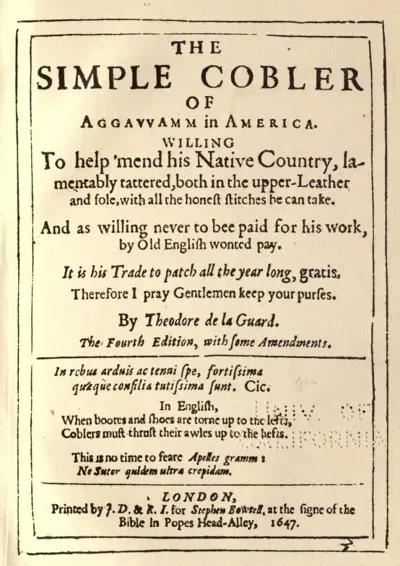
Nathaniel Ward was a Puritan clergyman and pamphleteer in England and Massachusetts. He wrote the first constitution in North America in 1641.
