Joycelyn Elders Quotes
We have young men with shoes which light up when they walk and a brain that seems dead when they talk.
Joycelyn Elders, Surgeon General of the United States, Director, Arkansas Department of Public Health, State of Black America Forum, February 26, 2005
Sourced by: Eigen's Political and Historical Quotations


Incredibly enough, after the Civil War and emancipation, most Virginia leaders opposed any form of rights for Blacks with one of the major reasons being that they were ignorant and uneducated. It was actually a crime to teach even a free Black to read.

The organization was initially called the National Negro Committee. The following year the name was changed to the National Association for the Advancement of Colored People. Note that at the time, even for Blacks, the concept of desegregation was so far from reality that their efforts were simply to have segregated schools with the same resources as the white children had. The “separate but equal” doctrine was the method of the segregationists.
There was no Federal Program to pay for teachers of the recently freed slaves who had been prohibited by Southern State’s laws from learning to read or write at all. The Southern States were a shambles as a result of the war. An NGO raised private money to provide some education to Blacks, not a popular activity for most white Southerners.

In 1831 a slave preacher, Nat Turner, led a rebellion in North Carolina killing over 50 white men. Even though Turner and the rebels were captured and executed, whites throughout the South, took vengeance on any slaves they could find.


By 1870 there were over 1000 schools in the South that had been founded and operated by the Freedmen’s Bureau. Despite the racist, negative stereotypes of Negroes, many of them were just the opposite from the stereotype as this quotation demonstrates.

This has been a constant theme of many African Americans regarding the path to Black advancement in America—self effort. Others claimed the the path was to change the external discriminatory forces in the nation. They were both right, and we have learned since that neither alone will accomplish the objective.


For more about the Bureau. See {629186} and {629187}.
For more about the Bureau. See {629185}.and {629187}.

He was a deeply religious Christian which is one of the reasons that he was appointed to head the Freemen’s Bureau to integrate the emancipated slaves into society. Howard University was named for him, and he served as its First President. For more about the Bureau. See {629185}.and {629187}.

In the early 20th century, Carver and Du Bois were the two most important Negro leaders in America. However, they disagreed over tactics. Carver tended to believe that if the Negro would be educated and trained for meaningful occupations, he would rise in the eyes of the whites and discrimination would diminish. Du Bois was more cynical as can be seen in this quotation as he looked back on history when he was 95 and close to death. He had the advantage at this time of seeing that Washington’s strategy had failed, but he opposed Washington on this from the beginning. Most whites preferred Washington’s view as whites were relived of immediate moral responsibility for racism and the burden was placed on Blacks to train, develop and display themselves as worthy. It was only when very large numbers of Blacks had done this and nothing much changed in terms of civil and economic rights, that it was clear that Washington’ view had been hopelessly naïve.


This high school is one of the better schools in the country with a terrific track record of graduation and college attendance with a mostly poor, minority population—especially boys. They have a very intensive, total time consuming curriculum focused on technology careers. The time on task is their most distinguishing feature. Students in such a school program actually spend up to 2 hours a day in active learning more than students in most high schools. This is one third more time that these students spend in active learning.

Many historians of higher education to not agree with Wilder’s overall generality. However, it was certainly the case that slavery was a major factor in generating the funds for some early universities in the North, but others were “hotbeds” of abolition from their very inception.

This song and this musical was a profound attack on the essence of racial segregation at a time when discrimination was legal and practiced throughout the country and almost universally in the South. Southern politicians castigated the song, the show, and especially Hammerstein who they called a Communist for promoting such radical views. Ironically, South Pacific became one of the most frequently produced High School Shows by 1979 and remained so into the 21st century including in the South.

The mental conditioning and brainwashing that was forced upon slaves in the American Chattel Slavery system was a major factor in the poor intellectual, analytical, emotional, and egocentric and moral development of Black slaves.

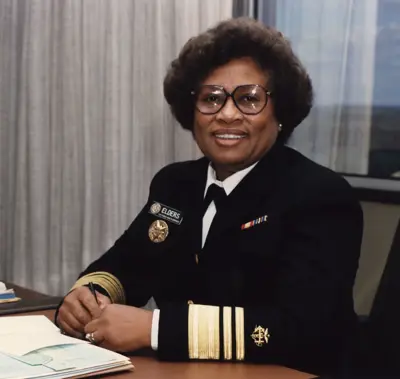
Minnie Joycelyn Elders is an American pediatrician and public health administrator who served as Surgeon General of the United States from 1993 to 1994. A vice admiral in the Public Health Service Commissioned Corps, she was the second woman, second person of color, and first African American to serve as Surgeon General. Elders is best known for her frank discussion of her views on controversial issues such as drug legalization, masturbation, and distributing contraception in schools. She was forced to resign in December 1994 amidst controversy as a result of her views. She is currently a professor emerita of pediatrics at the University of Arkansas for Medical Sciences.
