Michael Dyson Quotes
Almost half of the Black young men in America are not employed. There are not that many lazy people in the entire country..
Michael Eric Dyson, Author and Scholar, “Status of Black Males”, Congressional Black Caucus, July 24, 2013
Sourced by: Eigen's Political and Historical Quotations


This quotation illustrates the degree or irrationality that Southerners practiced in considering racial matters. Lee was stating what virtually all Southern “Gentlemen” believed. Here was a class of people who had hardly worked at day in their lives opining on the work attitudes of the class of people who did most of all the work in the South. The Southern Whites not only expected the Negro slave to do the work, but to be enthusiastic about working. And it never even occurred to Lee and most of the other whites that Negro lack of “disposition” to work was the result of the fact that they were forced to work with the benefits going to someone else. It was a character flaw in Blacks, if they were not enthusiastic and disposed to work when forced to. One of the few ways a slave could register his/her protest was to beat the system now and then and do as little work as possible. Free Blacks in the North were among the hardest and most enthusiastic working people in America—certainly moreso than the Southern white gentlemen.


Sumner would later become a Senator. However over a century before Brown v. Board of Education finally outlawed segregated schools, Sumner made one of the basic legal arguments that was involved in the case.


Incredibly enough, after the Civil War and emancipation, most Virginia leaders opposed any form of rights for Blacks with one of the major reasons being that they were ignorant and uneducated. It was actually a crime to teach even a free Black to read.

Ever since the Civil War, there has been an imbalance between the areas of the country with large unemployed populations and those areas where jobs were available. Even in 1870, the authorities were trying to get the unemployed to relocate but this was a hard thing to do at the time—physically, economically, and psychologically. It was not until the 2nd World War when huge numbers of Blacks migrated from areas of poor economic prospects in the South to areas of opportunity in the North. Also, note the classic welfare dilemma expressed whereby if humanitarian assistance is provided, people will not be desperate enough to move to areas with better opportunities.


A Southern Republican congressman with a voting record that was against minority interest, for the first time in American, interrupted and insulted the President of the United States in the midst of an invited Presidential Address to Congress given by Barack Obama, calling him a liar. Carter, himself a Southerner, recognized the motivation.


Henry Ford had more than doubled the market wages of workers and shortened the work day. In his young years he hired Negroes to work on the Assembly line with whites. In his older years he would not when he had become a Hitler and Fascist admiring racist. This was of the Black migrations to Detroit to work in the Auto industry. See {642361} for Ford’s wage announcement.


Given that the Black population is less than 15 percent of the total, the odds against this occurring by chance is less than 100 million to one. The problem was then very hard to solve in that in most cases the cause was not anti-Black hostility. Rather it was that most police—including some Black police officers—were more fearful for Black males relative to white males and perceived themselves or the public in mortal danger much more often with Blacks than with whites in similar situations. Much of this was a historical societal bias and fear of Black males and much was the result of the disproportionate media depiction of violent Black males.


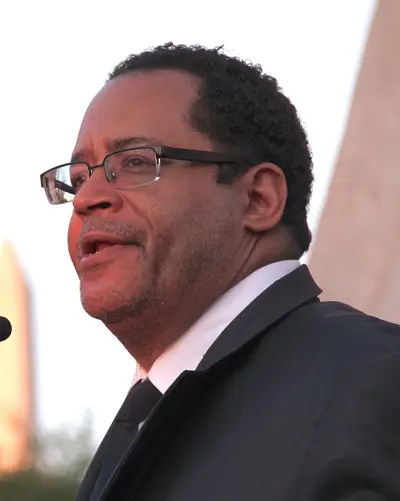
Michael Eric Dyson is an American academic, author, and radio host. He is a professor of Sociology at Georgetown University. Described by Michael A. Fletcher as "a Princeton Ph.D. and a child of the streets who takes pains never to separate the two", Dyson has authored or edited 18 books dealing with subjects such as Malcolm X, Martin Luther King, Jr., Marvin Gaye, Nas's debut album Illmatic, Bill Cosby, Tupac Shakur and Hurricane Katrina.
