Boniface VIII Quotes
We declare, say , define, and pronounce that it is absolutely necessary for the salvation of every human creature to be subject to the Roman Pontiff.
Boniface VIII. "Unam Sanctam." A Source Book for Mediaeval History, edited by Oliver J. Thatcher and Edgar H. McNeal, Charles Scribner's Sons, 1905, p. 317.

The Roman Catholic Church then maintained that salvation was dependent upon obedience to the Pope in all things civil and religious. See {595166} for the way that the Church at the time allowed some authority to civil authorities.

John Ilyitch Sergieff. The power of the leadership of organizations, religious and secular, has long been in contention. There are those who advocate the strong, very powerful executive such as Russia under the Czars and the Roman Catholic Church and those who prefer a weaker leader with very limited power such as the United States and the Russian Orthodox Church.


The letter was written at the behest of the Archbishop of Canterbury. The quotation appears to ratify the Pope’s unlimited power, but in actuality carves out an exception whereby the Pope’s authority might be challenged in the future. Specifically, it claims the Pope has not the authority to alter that which “by the word of God, has eternal validity.” Politically, this position put the pope in a box. By arguing against the proposition, the Pope would have to maintain that he should have the right to alter the word of God that had eternal validity which no pope wanted to state. By not challenging the doctrine, there was an opening by which the pope’s omnipotence could be challenged in the future.


This concept is not terribly different from the concept of the theocracy of the Islamic government of Iran in the 21st century. There is a civil government but it serves and is “under the direction of the spiritual power.”


At the time the Pope had secular, diplomatic relationship with many of the states of Europe:

This notice of Excommunication was promulgated to the Catholic clergy in Ireland in May of 1538. It required all Roman Catholic leaders to size the property of Protestants or Catholics who sympathized with them. Those who did were then regarded as traitors by the Protestant King. The anti-Protestant feeling culminated with the massacre of about 100 Protestants who were drowned in Bann a few years later.

This quotation is often used to illustrate the complete intellectual conformity that was (and for some still is) required of the Roman Catholic Church. Although this was a theological statement, it is sometimes functionally used as a definition of loyalty to a President or other political figure with respect to staff.

This quotation shows the unique relationship that the Irish Republic has had with the Catholic Church. There was probably no other non Muslim country in the world where a political leaders could get elected avowing this kind of loyalty and control by a religious heirerchy. See {639726} for an even more Irish, drastic departure from the concept of separation of church and state.


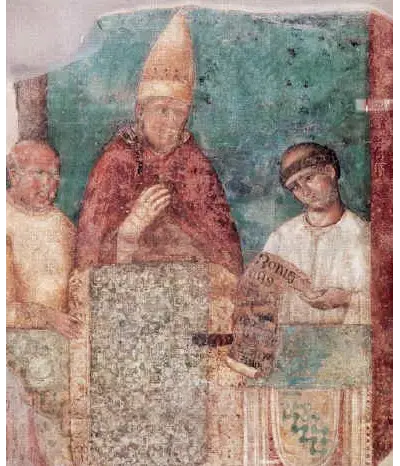
Pope Boniface VIII was pope from 24 December 1294 to his death in 1303. Caetani was of baronial origin with family connections to the papacy. He succeeded Pope Celestine V, a Benedictine, who had abdicated from the papal throne. Boniface spent his early career abroad in diplomatic roles. In the College of Cardinals, he discriminated not only against the Benedictines but also members of the Colonna family, some of whom had contested the validity of the 1294 papal conclave that elected him following the unusual abdication of Pope Celestine V. The dispute resulted in battles between troops of Boniface and his adversaries and the deliberate destruction and salting of the town of Palestrina, despite the pope's assurances that the surrendering city would be spared.
