Frederick Barbarossa Quotes
On Earth, God has placed no more than two powers, and as there is in Heaven but one God, so is there here one Pope and one Emperor. Divine providence has specially appointed the Roman Empire to prevent the continuance of schism in the Church.
Bryce, James. The Holy Roman Empire. Macmillan and Co., 1904, p. 173.


This concept is not terribly different from the concept of the theocracy of the Islamic government of Iran in the 21st century. There is a civil government but it serves and is “under the direction of the spiritual power.”

John Ilyitch Sergieff. The power of the leadership of organizations, religious and secular, has long been in contention. There are those who advocate the strong, very powerful executive such as Russia under the Czars and the Roman Catholic Church and those who prefer a weaker leader with very limited power such as the United States and the Russian Orthodox Church.

His response was to being asked whether he could do something with Russian Catholics to help Laval win favor with the Pope, to counter the increasing threat of Nazism. This quotation is often used as an example of Stalin’s disrespect for the Papacy. However, in this case, the Pope was extremely weak politically and some argue spiritually for he did not oppose Hitler and the Nazis very much. Defenders of the Papacy argue that Hitler had overwhelming force and little respect for the Pope, and ironically this was what Stain was referring to. Ironically, another Pope, John Paul, had a major part in bring down the Soviet Union and he had no divisions.


At the time the Pope had secular, diplomatic relationship with many of the states of Europe:


This vision, known as "The Third Rome" saw not only Moscow as the seat of Christianity for the world, but saw the Czar as the Head of the Christian unified Church. Constantinople had fallen to the Muslims and Rome to the Barbarians and the Pope had virtually no power at the time. Particularly interesting is his vision of transforming a civil Emperor to the head of the Church—one who was strong and wealthy enough to end the schism of the Eastern and Western Churches and command all. In this sense, he was following the Muslim concept of a single secular and religious, all powerful, leader—like the Caliph.


She was running for the United States Senate. God must have chosen her opponent as she lost.


Ingersoll was considered to be the greatest orator and political thinker of his day, but his overt atheistic views curtailed his elected political career.


At the time there was no pope. Before an election for one was held, all the electors made the collective oath and promise to maintain the idea of a council of clerics if he were elected Pope. After the Pope was elected, the bishops solidified their power even claiming ascendancy and authority, when assembled, over the Pope. See the Council of Constance {610980} 6 years later.


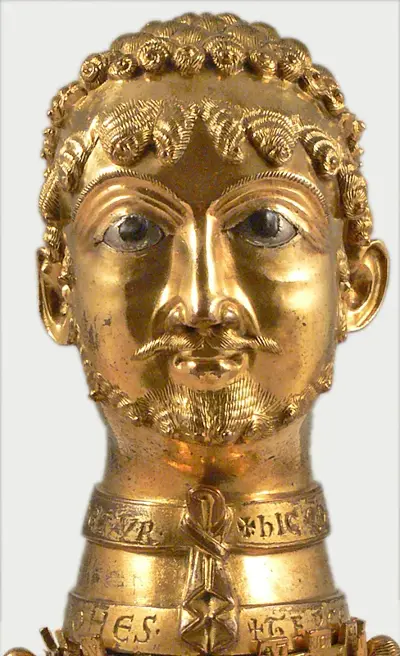
Frederick Barbarossa, also known as Frederick I, was the Holy Roman Emperor from 1155 until his death 35 years later. He was elected King of Germany at Frankfurt on 4 March 1152 and crowned in Aachen on 9 March 1152. He was crowned King of Italy on 24 April 1155 in Pavia and emperor by Pope Adrian IV on 18 June 1155 in Rome. Two years later, the term sacrum ("holy") first appeared in a document in connection with his empire. He was later formally crowned King of Burgundy, at Arles on 30 June 1178. He was named Barbarossa by the northern Italian cities which he attempted to rule: Barbarossa means "red beard" in Italian; in German, he was known as Kaiser Rotbart, which has the same meaning. The prevalence of the Italian nickname, even in later German usage, reflects the centrality of the Italian campaigns to his career.
