Montesquieu Quotes
We are poor with all the wealth and commerce of the entire universe, and soon, on account of having solders, we shall have nothing but soldiers, and we will become like the Tartars.
Charles de Montesquieu, 1689-1755, French Lawyer, Writer & Political Philosopher, Opposition to a standing army
Sourced by: Eigen's Political and Historical Quotations


Napoleon was referring to the Elector of Hesse-Cassel. who “rented” his citizens out as soldiers (the Hessians – from Hesse), making money for himself by paying them a fraction of what he was paid for each soldier. Napoleon thought that providing merceneries to other nations for money was an immoral and disgusting thing for a leader to do.


The Hun were a very fierce, Asian people who under Attila, defeated the troops of the Roman Empire and sacked several Italian cities. They fought very intensely and terrorized their enemies. The Kaiser came under great criticism from other European powers from urging his soldiers to emulate vicious barbarians with no sense of Christian morality.

There were many Americans and Mexicans who believed that the conquest of all of Mexico was well under way, our having earlier obtained Texas, New Mexico, Colorado, California, and Arizona.

Part of French Sudan—now Mali. This was a Province of the Fulani Islamic Empire, Bambara, of the Greater Sudan. Despite fierce resistance, the French prevailed and colonized the territory. Muntaga, the brother of the Tukulor Islamic ruler Amhadu , provided a great example of the fiery rhetorical style which survives to this day in much of the Islamic world.

Ironically, when he attacked Athens in 480 BC, the Athenians under Themistocles, abandoned the city—see {612656}—and lured the overly-confident Xerxes into a sea battle at Salamis where the Persians were totally destroyed. A few public buildings of Athens were burned, but before Xerxes could fulfill his vow, he was defeated and had to retreat to Persia.

Paine was describing the conquest of England in 1066 by William the Conqueror.

Egypt was miserably governed by the Ottoman Turks. The people had no rights or freedoms and poverty and ignorance was universal. Napoleon, came to Egypt in much the same way as the United States did in Iraq two centuries later—with the assumption that bringing freedom and affluence, modern government, and a greater expectation of standard of living would find favor with most of the downtrodden inhabitants. However, although the Egyptians hated their status quo, it was culturally something they were comfortable with. It was Islamic and not Christian or secular as much of France was. Yet occupation by these foreigners was more onerous culturally than occupation by the Islamic Ottoman Turks.

Some politicians wrongly think that this is was first an American idea. Spinoza’s ideas were considered so radical and dangerous that he was the only man in history who was excommunicated by the Catholics, the Jews and the Muslims.

While Mangin was disgustingly racist, many native soldiers from Senegal, Morocco and other French colonies were pleased that Mangin was not only advocating that they serve with the French Army, but the General was critical of the fighting spirt of the then contemporary Frenchmen and claimed that the “prmitives” would invigorate the French Army. Mangin’s view was adopted as policy and in the First World War, native colonial troops were an important component of the victorious French Army.


The profits that England made on the North American Colonies and the Caribbean were very large. 10 years before the American Revolution most sophisticated English politicians realized that and one of the reasons the British fought so hard to keep America from Independence was that money.
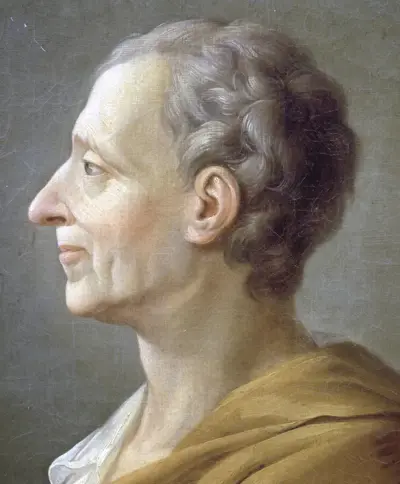
Charles-Louis de Secondat, Baron de La Brède et de Montesquieu, generally referred to as simply Montesquieu, was a French judge, man of letters, and political philosopher.
