Samuel Johnson Quotes
To a people warlike and indigent, an incursion into a rich country is never hurtful.
Johnson, Samuel. A Journey to the Western Islands of Scotland. W. Strahan and T. Cadell, 1775, p. 120.


Ironically, when he attacked Athens in 480 BC, the Athenians under Themistocles, abandoned the city—see {612656}—and lured the overly-confident Xerxes into a sea battle at Salamis where the Persians were totally destroyed. A few public buildings of Athens were burned, but before Xerxes could fulfill his vow, he was defeated and had to retreat to Persia.

See {613496} for the origin of the “thrashing a cannibal” phrase.

This concept of Total War turns out to be the only way to bring many conflicts to an end. Sherman was hated by generations of Southerners because he appeared to be vengeful to humble the Southern pride and spirit. But actually, Sherman was not personally vengeful at all and respected the South and understood its point of view more than most in the North. However, he was one of the first of the Western World’s military leaders to realize that with modern warfare and the then modern weapons, the only way to win a war was to persuade the enemy to stop fighting and if they refused, as the South kept doing, the only rational and humane course was to end the war as swiftly and totally as possible.


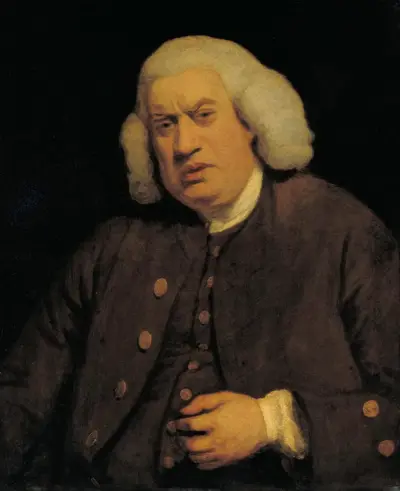
Samuel Johnson, often referred to as Dr Johnson, was an English writer who made lasting contributions to English literature as a poet, playwright, essayist, moralist, literary critic, biographer, editor, and lexicographer. Religiously, he was a devout Anglican, and politically a committed Tory. The Oxford Dictionary of National Biography describes Johnson as "arguably the most distinguished man of letters in English history". He is the subject of James Boswell's The Life of Samuel Johnson, described by Walter Jackson Bate as "the most famous single work of biographical art in the whole of literature".
