Ron Paul Quotes
Throughout the 20th century, the Republican Party benefited from a non-interventionist foreign policy. Think of how Eisenhower came in to stop the Korean War. Think of how Nixon was elected to stop the mess in Vietnam.
Paul, Ron. "Bloomberg/Washington Post Republican Presidential Debate." Bloomberg, 11 Oct. 2011.


Most American felt that way at the time of the Russian occupation and the Mujahedeen resistance.


The occasion was the visit to Washington of French Minister M. Jean Letourneau. The French were fighting the communists in Vietnam and the U. S., not yet in the fight, promised material and political aid, but no military participation. It was almost a decade later that America sent its first military personnel to Vietnam. The West was persuaded that the French could handle the situation. When they were defeated, America and Britain assumed that it was the notorious military incompetence of the French that accounted for the situation rather than the competence and commitment of the Vietnamese Communists and their support of the majority of the people.


President Johnson had invited Ike to the White House to advise about the Vietnam War in general and the Rolling Thunder operation in particular. President Eisenhower’s quotation was one of the clearest statements of the so-called Domino Theory which was believed by almost all American Military and Foreign Policy leaders. It was tragically wrong, but it drove U. S. policy throughout the war. When the Communists took South Vietnam, there was no subsequent Communist takeover or attempt in any of the countries Eisenhower had enumerated. One of the reasons was that the Vietnam Communists were not very close to the Russians and for over 1000 years had considered China their worst enemy. They had little solidarity with the International communist movement, but American intelligence did not realize that. They did not believe that the ethnic hatred between Vietnam and China would inhibit the Vietnamese in modern times. It did. Even after the war, the Vietnamese developed better relations with the U. S. then they had with China. One of the major things the intelligence and policy operators missed was that there was not a single map in China that showed Vietnam as a country. To the Chinese, it has always been a part of China and they want it to be in the future. The Vietnamese have not agreed for a millennium.
The reference to Munich referred to British Prime Minister meeting with Adolf Hitler in Munich, giving Germany some of their demands while receiving assurances that there would be no further aggression. This appeasement just encouraged Hitler to take more and soon he had invaded all of Europe beginning World War II. The view since has been that a dictator must never be appeased in unjust aggression, even on relatively small items. What made the Vietnam War so complicated was that while it appeared that the attacks on South Vietnam by Communist North Vietnam was a first step of general Communist Aggression, the reality was that it was primarily a Civil War where the South was a massively corrupt, Catholic Controlled dictatorship and the North was a Communist dictatorship dominated by Buddhists. And there was major friction between the Vietnamese Communists and the Chinese Communists who were not working in concert for general Communist domination. The North Vietnamese were a nationalist movement. The Domino Theory had been wrong.


It was interesting that Reagan as a political presidential Republican candidate would criticize the foreign policy of the previous Republican Party. However the policy was created by President Richard Nixon who had but a small reservoir of support after Watergate.


1st Earl Baldwin of Bewdley. Baldwin has been castigated since WWII for being part of the “appeasement group” in England. As Prime Minister in 1935 he would not face the threat of Fascism, Germany and the Nazis and did not initiate a major arms buildup. Churchill, among others, never forgave him. See {626930} for Churchill’s view of Baldwin.


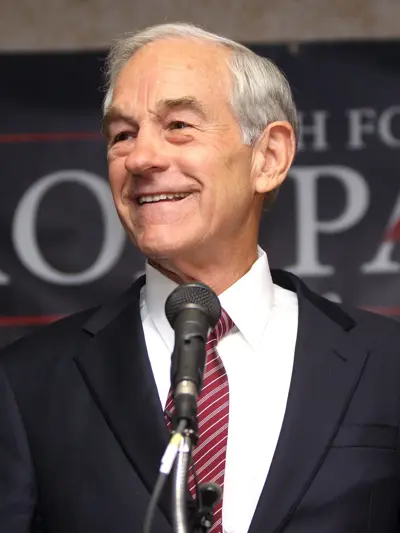
Ronald Ernest Paul is an American author, physician, and retired politician who served as the U.S. Representative for Texas's 22nd congressional district from 1976 to 1977 and again from 1979 to 1985, and for Texas's 14th congressional district from 1997 to 2013. On three occasions, he sought the presidency of the United States: as the Libertarian Party nominee in 1988 and as a candidate for the Republican Party in 2008 and 2012. A self-described constitutionalist, Paul is a critic of the federal government's fiscal policies, especially the existence of the Federal Reserve and the tax policy, as well as the military–industrial complex, the war on drugs, and the war on terror. He has also been a vocal critic of mass surveillance policies such as the USA PATRIOT Act and the NSA surveillance programs. He was the first chairman of the conservative PAC Citizens for a Sound Economy, a free-market group focused on limited government, and has been characterized as the "intellectual godfather" of the Tea Party movement, a fiscally conservative political movement that is largely against most matters of interventionism.
