Henry A. Kissinger Quotes
U. S. foreign policy in the 20th century was characterized by disastrous oscillations between over-commitment and isolation
Henry A. Kissinger, U.S. Secretary of State (Republican), U.S. National Security Advisor, Quoted in Bret Stevens, “Getting the GOP’s Groove Back”, Foreign Affairs, March / April, 2013
Sourced by: Eigen's Political and Historical Quotations


The issue of unilateral or multilateral foreign policy efforts faced America after WWII.


He was referring to the Early Cold War. The American official position and propaganda called for Russian military and political control of Eastern Europe to end and supported uprising and revolution, but the U. S. did not have the power to dislodge Russia without risking a nuclear war.
At the time our strongest allies in the Middle East were Monarchies, dictatorships, and Principalities. See {586706}


Ironically, at the time she wrote this column, Mrs. Roosevelt was being accused of being a communist by some Southerners who associated her strong views against racism and segregation. Some in the North thought she was a communist because of her active role in the New Deal, Yet here she was, willing to use military force to prevent Soviet expansion.


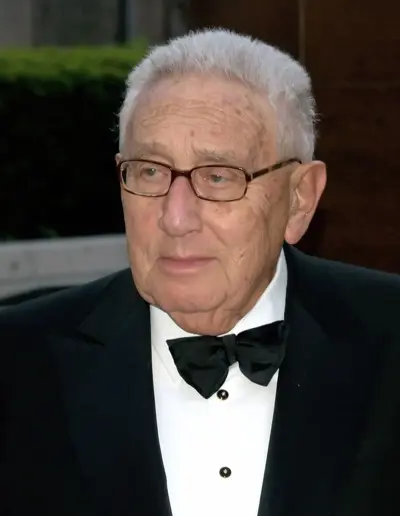
Henry Alfred Kissinger KCMG is an American politician, diplomat, and geopolitical consultant who served as United States Secretary of State and National Security Advisor under the presidential administrations of Richard Nixon and Gerald Ford. A Jewish refugee who fled Nazi Germany with his family in 1938, he became National Security Advisor in 1969 and U.S. Secretary of State in 1973. For his actions negotiating a ceasefire in Vietnam, Kissinger received the 1973 Nobel Peace Prize under controversial circumstances, with two members of the committee resigning in protest.
